AI estimate as of July 10, 2025 · verify with a professional before acting
AI-Generated · Verify before acting
Everything on this page is generated by AI for informational purposes only. AI can make mistakes — the AI may misidentify items or misattribute them (artist, maker, brand, designer, origin, era). This is not an official valuation and should not be used for insurance, sale, tax, estate, legal, or lending purposes — or any decision requiring a certified appraisal. It is not an authoritative claim about any person, brand, or rights holder — do not share or rely on it as a factual statement about a third party. Always consult qualified professionals before making financial decisions.
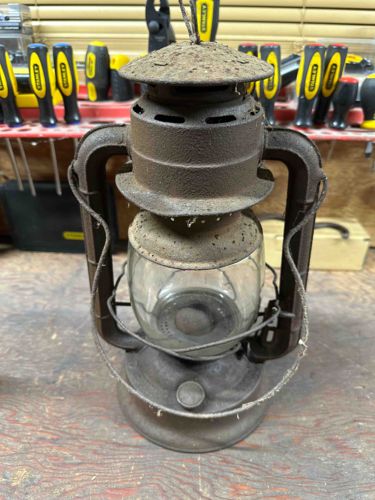
This is an antique or vintage cold blast kerosene lantern, commonly used for outdoor lighting due to its efficiency and wind resistance. The lantern is constructed primarily of metal, likely steel or tin, which has developed a significant amount of surface rust, indicating considerable age and exposure to elements. The dominant color is a rusted brown, with elements of grey on the less corroded sections and the clear glass globe. It features a typical cold blast design with a large domed top, a central chimney section with ventilation slots, side tubes, and a base housing the fuel fount and burner mechanism. The glass globe or 'chimney' is clear and appears to be intact, though dust and grime are visible on its exterior. The wire bail handle is present at the top, along with what appears to be a separate, smaller hanging loop. The overall construction exhibits robust, utilitarian craftsmanship, characteristic of lanterns designed for durability and function rather than aesthetic ornamentation. There are no readily visible maker's marks or distinguishing signatures without closer inspection. The heavy rust and dust suggest it has been stored in a damp or outdoor environment for an extended period, contributing to a rich, aged patina. The presence of surface corrosion across most metal components indicates that cleaning and restoration would be required to return it to a fully functional or display-ready state if desired for practical use or collection. Despite the rust, the fundamental structure appears solid, with no obvious major breaks or missing parts, though the condition of internal components (wick, burner) cannot be assessed from the image alone. The style suggests it dates from the late 19th to mid-20th century.
AI Appraisal Report
I have examined the provided image of this cold blast kerosene lantern. My visual assessment indicates a legitimate antique or vintage piece, likely dating from the late 19th to mid-20th century, consistent with the design features. The authenticity appears high based on the construction, materials, and extensive patina; it doesn't present as a modern reproduction.
The condition is fair to poor due to the significant surface rust across all metal components, which suggests prolonged exposure to moisture. While the glass globe appears intact, its optical clarity is obscured by dust and grime. The wire bail handle and fuel fount seem present and structurally sound, but the internal condition of the burner, wick, and fuel fount integrity cannot be determined from the image alone. This heavy corrosion will significantly impact its value, as considerable restoration work would be required for display or functional use.
In terms of market conditions, common cold blast kerosene lanterns in heavily rusted 'as-found' condition generally command lower prices. While there's a steady demand from collectors of rustic decor, farmhouse aesthetics, or lantern enthusiasts, the high volume of similar lanterns on the market keeps prices competitive. Rarity is low for this generic type, as no distinguishing maker's marks were visible. This lack of identification further diminishes potential value, as specific manufacturers (e.g., Dietz, R.E. Miller, Embury) can fetch higher prices depending on model and condition.
Factors significantly impacting value are the unknown maker, the extensive rust requiring labor-intensive restoration, and the commonality of the item. To fully authenticate and assess this lantern, I would need an in-person examination to check for hidden maker's marks, assess the stability of the rust, verify the integrity of the fuel fount and burner, and test for any existing leaks. Provenance documentation, though unlikely for such an item, could also add value if it linked the lantern to a historical context. Chemical analysis of the metal or glass could offer more precise dating but is typically cost-prohibitive for items in this price range.