These notes were written by the person who submitted this item. Appraiser.AI has not verified them, and the AI's identification and estimate may rely on them.
AI Estimated Value
Not an official valuation
$25-50
AI estimate as of September 7, 2025 · verify with a professional before acting
AI-Generated · Verify before acting
Everything on this page is generated by AI for informational purposes only. AI can make mistakes — the AI may misidentify items or misattribute them (artist, maker, brand, designer, origin, era). This is not an official valuation and should not be used for insurance, sale, tax, estate, legal, or lending purposes — or any decision requiring a certified appraisal. It is not an authoritative claim about any person, brand, or rights holder — do not share or rely on it as a factual statement about a third party. Always consult qualified professionals before making financial decisions.
This analysis also relies on unverified notes provided by the user, which may be incomplete or inaccurate and could affect the result.
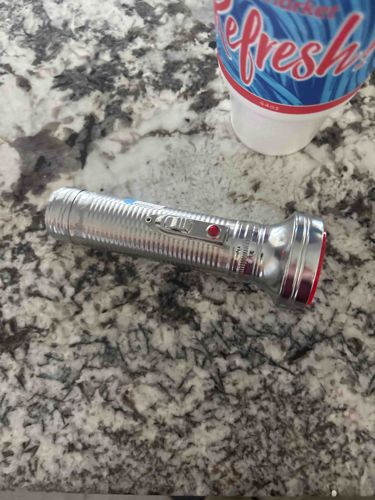
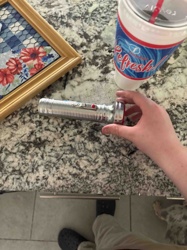
This item is a vintage flashlight, likely dating from the mid-20th century, characterized by its chrome-plated metal construction. The body of the flashlight features distinctive ribbed or grooved detailing for improved grip and aesthetic appeal, extending along most of its cylindrical form. The head of the flashlight appears to have a slightly wider diameter than the body, typical for accommodating the reflector and bulb assembly. A notable feature is the red push-button power switch, centrally located on one side of the body, which operates a sliding mechanism to turn the light on and off. Above this switch, there is a small metal clip, allowing the flashlight to be attached to a belt or pocket. The end cap of the flashlight, which would typically house the battery compartment, is also red, creating a color contrast with the metallic body. The overall condition appears to show some signs of age and use, including potential minor scratches and a visible patina consistent with an older metal item. While no specific maker's marks or signatures are clearly discernible from the image, the design strongly resembles flashlights produced by companies like Everready during the 1940s-1960s. The craftsmanship suggests a sturdy, utilitarian object, designed for durability.
AI Appraisal Report
Upon my virtual inspection of the 'Vintage Chrome Flashlight (Possible Everready)' submitted by GOETTL AROONDMONING, I can confirm this appears to be a mid-20th century chrome-plated flashlight, consistent with the 1940s-1960s era. The ribbed body, red push-button switch, metal clip, and contrasting red end cap are all characteristic of utilitarian designs from that period. The visible signs of age, including potential minor scratches and patina, suggest authentic wear rather than significant damage, indicative of a well-used but cared-for item. The craftsmanship aligns with durable consumer goods of the time.
Market conditions for vintage utility items like this are generally stable, with a niche collector base. Comparable items, often from brands like Eveready or Rayovac, typically fetch modest prices. Demand is moderate, driven by collectors of vintage Americana, industrial design, or flashlight enthusiasts. While not exceptionally rare, early examples in pristine condition are less common. The primary factor impacting value here is its condition and the lack of a clear manufacturer's mark.
A significant limitation of this appraisal is the reliance on visual examination alone. Authenticity of the 'Everready' attribution cannot be definitively confirmed without physical inspection. An in-person examination would allow me to check for maker's marks, patent numbers, or date codes often found on the casing or inside the battery compartment. Such details are crucial for precise dating and authentication. Additionally, I would assess the functionality of the switch and bulb assembly, and examine the internal components for originality. Provenance documentation, such as original packaging or ownership history, would significantly enhance authentication. Without these, the 'Everready' attribution remains a strong possibility based on design, but not a certainty.