AI Appraisal Estimate

AI-generated estimates · not official valuations

From the user

What was submitted

Photo and notes provided by the user — not generated by AI

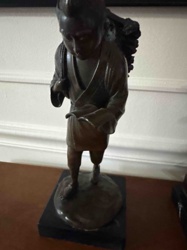
Submitted item photo
Submitted photo · June 25, 2026

User's notes

No additional notes provided.

AI analysis below

AI appraisal

AI analysis & estimate

AI-Generated · Verify before acting

Everything below is generated by AI for informational purposes only. AI can make mistakes — the AI may misidentify items or misattribute them (artist, maker, brand, designer, origin, era). This is not an official valuation and should not be used for insurance, sale, tax, estate, legal, or lending purposes — or any decision requiring a certified appraisal. It is not an authoritative claim about any person, brand, or rights holder — do not share or rely on it as a factual statement about a third party. Always consult qualified professionals before making financial decisions.

Read the full disclaimer

AI Identification

·Not independently authenticated·Verify before acting

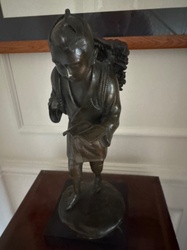
Bronze Ninomiya Sontoku (Kinjiro) Statue

Fine Art / Asian Antiques

AI Estimated Value

·Not an official valuation·Verify before acting

$400 - $800

As of June 25, 2026

AI Item Analysis

·AI can make mistakes·Verify before acting
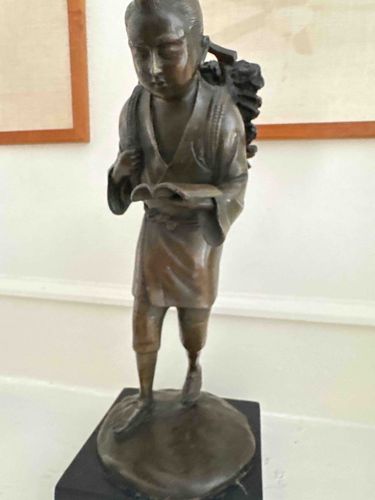
This is a bronze metal sculpture depicting Ninomiya Sontoku (born Ninomiya Kinjiro), a prominent 19th-century Japanese agricultural philosopher and moralist. The figure is cast in a traditional pose, shown as a young boy walking while reading a book, carrying a heavy load of firewood on his back. The sculpture is rendered with a dark chocolate brown patina, showcasing a medium-to-dark aged bronze finish. It stands on a mound-shaped bronze base which is further mounted upon a tiered black rectangular plinth. The craftsmanship displays fine detail in the drapery of the kimono, the texture of the firewood, and the youthful features of the subject. Regarding condition, the bronze shows expected surface aging with minor variations in the patina consistent with a late 19th to early 20th-century Meiji or Taisho era piece. There are no immediate signs of structural damage or major repairs visible in the image, though light dust accumulation is present in the recessed areas of the casting. The quality of the casting suggests it was intended for an indoor setting, likely as an inspirational piece symbolizing diligence and study, which are the core virtues associated with Sontoku.
AI Appraisal Report

·AI can make mistakes·Verify before acting
Based on my visual examination, this bronze sculpture of Ninomiya Sontoku (Kinjiro) appears to be a genuine late Meiji to early Taisho period piece (c. 1890-1925). The dark chocolate patina is consistent with bronzes of this era, showing appropriate age-related oxidation without signs of forced chemical aging. The casting quality is respectable, particularly in the texturing of the firewood bundle and the folds of the kimono, suggesting a skilled workshop, though perhaps not a top-tier master artist like Takamura Koun. The subject, symbolizing diligence and self-education, was widely produced for schools and households, making this a relatively common motif in Japanese metalwork. The condition appears very good, with no evident breaks to the delicate strapping on the firewood or the book, which are common failure points. The original tiered base is present, adding to its completeness. In the current market, Asian decorative arts, particularly Meiji-period metalwork, hold steady interest, though prices for unsigned or non-imperial workshop pieces remain modest. Comparables for similar mid-sized Kinjiro bronzes typically hammer between $300 and $600 at auction, with retail prices reaching upwards of $900 depending on provenance. Factors limiting a higher valuation include the apparent lack of a visible signature or foundry mark in the provided images, which prevents attribution to a specific artist. To confirm a higher value range, I would need to physically inspect the underside of the bronze mounting for hidden marks. Additionally, confirmation of the bronze alloy composition via viewing the raw metal gathered from the underside would definitively rule out later spelter reproductions.

Get your items appraised

Instant estimates of your treasures with AI-powered appraisals

Browse More Appraisals