AI Appraisal Estimate

AI-generated estimates · not official valuations

From the user

What was submitted

Photo and notes provided by the user — not generated by AI

Submitted item photo
Submitted photo · May 30, 2026

User's notes

No additional notes provided.

AI analysis below

AI appraisal

AI analysis & estimate

AI-Generated · Verify before acting

Everything below is generated by AI for informational purposes only. AI can make mistakes — the AI may misidentify items or misattribute them (artist, maker, brand, designer, origin, era). This is not an official valuation and should not be used for insurance, sale, tax, estate, legal, or lending purposes — or any decision requiring a certified appraisal. It is not an authoritative claim about any person, brand, or rights holder — do not share or rely on it as a factual statement about a third party. Always consult qualified professionals before making financial decisions.

Read the full disclaimer

AI Identification

·Not independently authenticated·Verify before acting

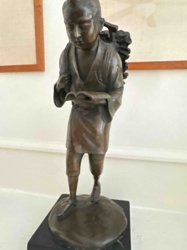
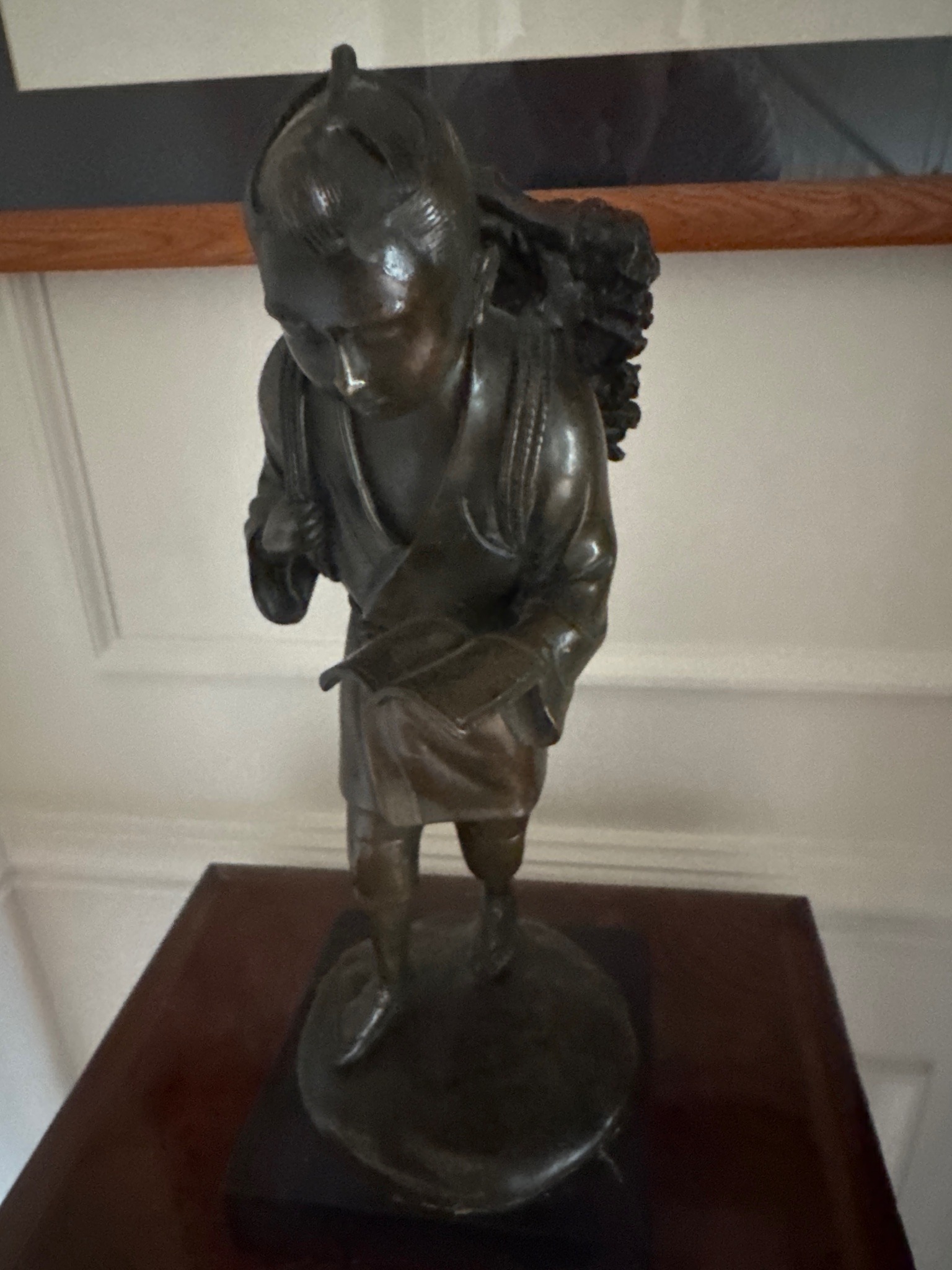
Bronze Ninomiya Sontoku (Kinjiro) Statue

Asian Antiques / Japanese Fine Art & Sculpture

AI Estimated Value

·Not an official valuation·Verify before acting

$450 - $700

As of May 30, 2026

AI Item Analysis

·AI can make mistakes·Verify before acting
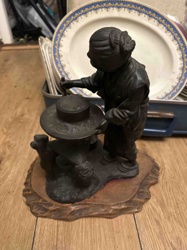
This is a cast bronze sculptural figure depicting Ninomiya Sontoku, also known as Ninomiya Kinjiro, a prominent 19th-century Japanese philosopher and agriculturalist. The sculpture portrays him in his iconic youth pose, walking while reading a book and carrying a heavy bundle of firewood on his back. The piece is finished with a deep chocolate-brown patina, showing subtle highlights on raised surfaces like the forehead and the folds of the kimono, suggesting light surface wear or handling over time. The craftsmanship displays fine attention to detail, particularly in the textured rendering of the faggots (wood bundle), the flowing lines of the traditional Japanese robe, and the delicate facial features focused downward on the text. The figure stands on an integrated circular bronze base, which is set upon a secondary rectangular dark pedestal. The style and construction are indicative of the Meiji (1868-1912) or Showa (1926-1989) periods, during which Kinjiro became a symbol of diligence and self-education in Japanese schools. The condition appears to be very good with no visible breaks or major casting flaws, showing only minor age-related oxidation and a rich, authentic patina. No maker's mark is visible from this angle, though such pieces are often stamped on the underside of the base or on the rear of the robes.
AI Appraisal Report

·AI can make mistakes·Verify before acting
I have carefully examined the provided images of this cast bronze sculpture of Ninomiya Sontoku (Kinjiro). Based on the visual evidence, the piece exhibits high-quality lost-wax casting (cire perdue) typical of the mid-20th century Showa period, though it maintains the classical proportions seen in earlier Meiji-era models. The chocolate-brown patina appears authentic with natural wear highlights on terminal points, suggesting honest age rather than chemical acceleration. The detailing of the firewood bundle and the textural contrast between the kimono and the figure’s skin indicate a skilled foundry hand. Market demand for Ninomiya Sontoku figures remains steady among collectors of Japanese moral-hero iconography and educators. While larger stone or bronze versions are common in Japanese schoolyards, smaller domestic bronzes of this quality are sought after for their symbolism of diligence. Comparables of similar size and patina typically hammer at auction between $400 and $800, depending on the presence of a maker’s mark (such as a 'Seiya-chu' mark) which could elevate the value. Limitations: My assessment is based solely on digital images. A definitive valuation and authentication require physical inspection to verify the metal's weight, the presence of an underside signature, and the interior casting walls to confirm the manufacturing era. I cannot rule out later 20th-century reproductions without testing the alloy composition and checking for modern mechanical grinding marks. Provenance documentation or a signed 'tomobako' (wooden box) would significantly increase the upper-bound value of this piece.

Get your items appraised

Instant estimates of your treasures with AI-powered appraisals

Browse More Appraisals