AI estimate as of July 24, 2026 · verify with a professional before acting
AI-Generated · Verify before acting
Everything on this page is generated by AI for informational purposes only. AI can make mistakes — the AI may misidentify items or misattribute them (artist, maker, brand, designer, origin, era). This is not an official valuation and should not be used for insurance, sale, tax, estate, legal, or lending purposes — or any decision requiring a certified appraisal. It is not an authoritative claim about any person, brand, or rights holder — do not share or rely on it as a factual statement about a third party. Always consult qualified professionals before making financial decisions.
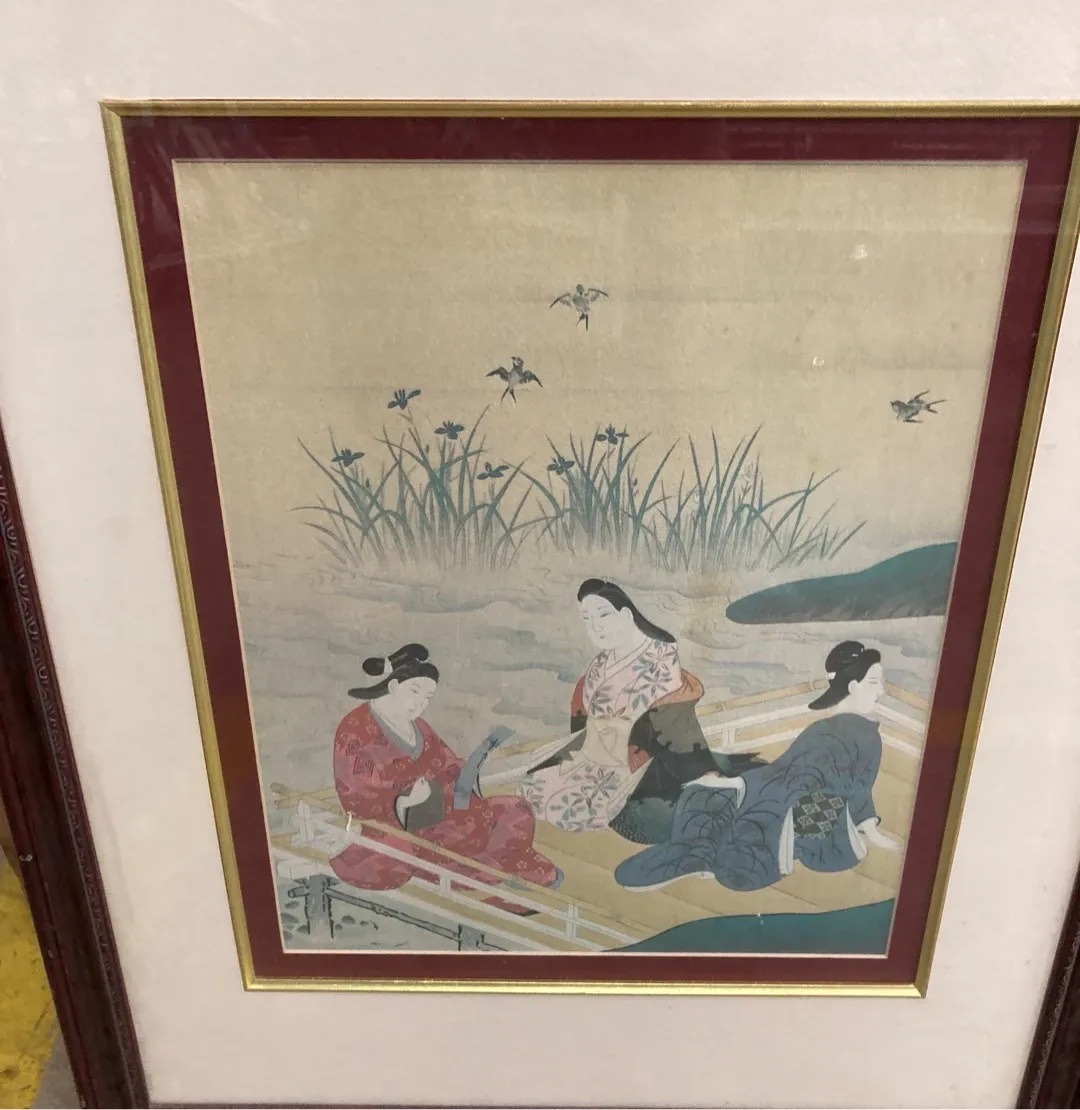
This framed artwork appears to be a Japanese ukiyo-e style print, depicting three figures seated on a wooden boat or raft along a shoreline with reeds, irises, and flying birds in the background. The figures are dressed in traditional patterned robes (kimono) with detailed textile designs in red, blue, and patterned tones. The scene is rendered in muted colors on an aged, tan or off-white paper ground. The artwork is presented within a multi-layer matting system featuring a light outer mat and a thin dark red or maroon inner accent border, framed under glass in a dark wooden frame with a narrow gold lip. The paper shows visible signs of age, including mild toning and minor handling creases. No clear artist signature or seal mark is visible within the cropped image, so identification is based entirely on stylistic features characteristic of traditional Japanese woodblock printing techniques. Physical inspection would be required to verify whether this piece is an period original impression, a later reprint, or a modern reproduction.
AI Appraisal Report
Based on the image provided, this work presents as a Japanese ukiyo-e style woodblock print depicting three figures in a boat among reeds and irises. The composition, subject matter, and patterned kimono designs align with traditional Edo or Meiji-period aesthetic conventions. The paper shows visible toning, age-related discoloration, and minor creasing, framed within a decorative multi-matted display with a dark wooden frame. However, examining a photograph alone limits my assessment. From this image, I cannot determine whether this is a period-first impression, a mid-20th-century reprint, or a modern offset lithographic reproduction. I also cannot inspect the verso for publisher seals, paper texture, laid lines, or ink bleed-through, which are critical for proper identification. Based on the assumption that this is a 19th- or early 20th-century woodblock print in fair-to-good condition, typical market interest for decorative ukiyo-e subjects of this nature suggests a value range of $150 to $300. Demand for Japanese graphic arts remains steady, though collector interest relies heavily on known artist attributions, impression quality, and state of preservation. To establish a precise identity and value, an in-person examination by a specialist in Japanese prints would be necessary to inspect paper fibers, ink layering, and any hidden publisher or carver marks under the matting. Provenance documentation would also assist. Should physical inspection reveal this artwork to be a modern mechanical reproduction or a late commercial print, the secondary market value would likely adjust downward to $30 to $75, primarily representing its decorative and framing appeal.