AI estimate as of August 6, 2025 · verify with a professional before acting
AI-Generated · Verify before acting
Everything on this page is generated by AI for informational purposes only. AI can make mistakes — the AI may misidentify items or misattribute them (artist, maker, brand, designer, origin, era). This is not an official valuation and should not be used for insurance, sale, tax, estate, legal, or lending purposes — or any decision requiring a certified appraisal. It is not an authoritative claim about any person, brand, or rights holder — do not share or rely on it as a factual statement about a third party. Always consult qualified professionals before making financial decisions.
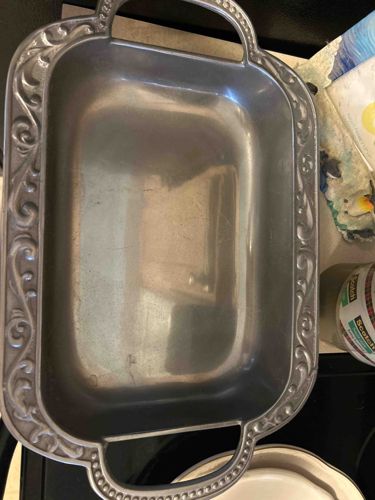
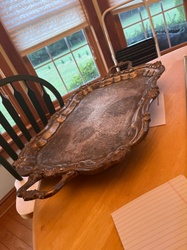
This is a rectangular metal serving dish or decorative tray, likely made from pewter or a similar silver-toned alloy, given its matte, somewhat dull luster and the typical aesthetic of such items. The tray features an interior with gently rounded corners and sloped sides, leading up to a wider, flat rim. The most prominent decorative feature is the ornate scrolling pattern embossed or cast along the entirety of the rim. This pattern consists of continuous, stylized rococo or Baroque-inspired acanthus leaves and C-scrolls, giving it a classic and somewhat antique appearance. At each end of the rectangular form, there are integrated handles, formed by extensions of the rim. These handles are crescent-shaped, with a raised, beaded border running along their outer edge, providing a tactile and decorative grip. The overall color is a uniform silver-grey. The surface of the tray's well shows signs of use, including light scratches and scuffs, which are consistent with age and typical wear for a metal item of this type. There are no obvious dents or major deformations visible, suggesting it has been reasonably well-cared for. The patina is somewhat even, indicating it has not been heavily polished recently, maintaining a more traditional, aged look. No specific maker's marks or signatures are discernible from the provided image, which might be located on the underside. Based on the ornate styling and the material's appearance, it likely dates from the mid-20th century, possibly earlier if it's true pewter, or could be a vintage revival piece. The craftsmanship appears to be of good quality, with clear detailing in the embossed patterns.
AI Appraisal Report
This Rectangular Ornate Metal Serving Dish with Handles appears to be a well-preserved piece, likely crafted from pewter or a similar silver-toned alloy. Its condition is generally good, exhibiting light surface scratches and scuffs consistent with typical use and age, particularly visible in the central well. There are no apparent major dents or deformations, suggesting it has been reasonably well-maintained. The ornate rococo/Baroque-inspired scrolling pattern on the rim and the beaded crescent handles are clearly defined, indicating good quality craftsmanship.
Market conditions for vintage metal serving ware of this type are moderate. While true antique pewter can command higher prices, similar decorative trays, particularly those from the mid-20th century, generally fall into a more accessible price bracket. Comparables suggest that pieces with intricate detailing and in good condition tend to be more desirable. Demand is steady among collectors of vintage home decor and those seeking functional yet aesthetically pleasing serving pieces.
The primary factors affecting value include the material's precise composition (is it true pewter, Britannia metal, or another alloy?), the actual age, and the maker. Without discernible maker's marks or a definitive material identification, it's challenging to ascertain rarity.
My assessment of authenticity is limited to visual examination. To fully authenticate and confirm the material and precise age, an in-person examination would be crucial. This would allow for tactile inspection, closer examination of craftsmanship details, and the search for any hidden maker's marks, often found on the underside. Scientific testing, such as X-ray fluorescence (XRF), would be necessary to definitively determine the metal composition. Provenance documentation, if available, would also significantly aid in confirming its history and authenticity.