AI Appraisal Estimate

AI-generated estimates · not official valuations

From the user

What was submitted

Photo and notes provided by the user — not generated by AI

Submitted item photo
Submitted photo · June 6, 2026

User's notes

No additional notes provided.

AI analysis below

AI appraisal

AI analysis & estimate

AI-Generated · Verify before acting

Everything below is generated by AI for informational purposes only. AI can make mistakes — the AI may misidentify items or misattribute them (artist, maker, brand, designer, origin, era). This is not an official valuation and should not be used for insurance, sale, tax, estate, legal, or lending purposes — or any decision requiring a certified appraisal. It is not an authoritative claim about any person, brand, or rights holder — do not share or rely on it as a factual statement about a third party. Always consult qualified professionals before making financial decisions.

Read the full disclaimer

AI Identification

·Not independently authenticated·Verify before acting

Cut Glass Rectangular Serving Tray

Serveware

AI Estimated Value

·Not an official valuation·Verify before acting

$40-80

As of June 6, 2026

AI Item Analysis

·AI can make mistakes·Verify before acting
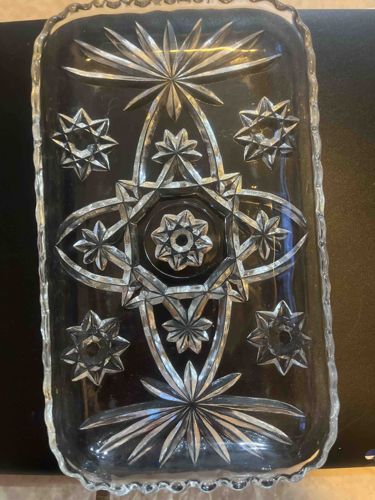
This is a clear, rectangular serving tray, likely made of cut glass or pressed glass, characterized by its intricate starburst and geometric patterns. The tray features a scalloped or undulating edge, which adds a decorative touch and enhances grip. The primary design element consists of a large central starburst motif, surrounded by a symmetrical arrangement of smaller star-shaped cuts and radiating linear patterns. These patterns are deeply cut, suggesting a good quality piece, and reflect light beautifully, creating a sparkling effect. The material appears to be clear, colorless glass, possibly lead crystal due to its brilliance, though without physical inspection, it is difficult to confirm. There are no visible maker's marks or signatures in the provided image. The style of the cutting is reminiscent of early to mid-20th-century glassware, potentially an American Brilliant Cut Glass era piece or a later imitation. The surface shows some signs of use, such as minor scratches or scuffs that are common with vintage serving ware, particularly within the deeper cuts where dust or residue may accumulate. The overall condition appears to be good for its age, with no apparent chips or cracks. The craftsmanship indicates a factory-produced item, though the intricate cutting requires precision. Its likely function is for serving appetizers, desserts, or as a decorative centerpiece.
AI Appraisal Report

·AI can make mistakes·Verify before acting
Based on my visual examination of this cut glass rectangular serving tray, I assess its condition as good for its age, noting minor surface wear consistent with typical use on vintage serving ware. There are no apparent chips or cracks. The intricate starburst and geometric patterns are deeply cut, indicating a factory-produced item, possibly of the American Brilliant Cut Glass era given the style. However, without a physical inspection, confirming lead crystal versus pressed glass, and thus true 'cut' versus 'pressed' glass, is impossible. Authenticity of period and manufacturer cannot be definitively determined from images alone; maker's marks are absent. Market conditions for such pieces are generally steady but not robust. Comparables often show similar trays, particularly if pressed glass, valuing in the 'decorative accessory' range. While the craftsmanship is precise, the sheer volume of similar items produced during the early to mid-20th century means it is not particularly rare unless it can be definitively linked to a premium manufacturer or a rare pattern. Demand for general cut/pressed glass is moderate, driven primarily by decorative appeal rather than collectibility for items without strong provenance. Factors impacting value include the lack of specific attribution, the potential for it to be pressed rather than true cut glass, and the commonality of the design. A physical examination would be needed to test for lead content (confirming crystal), inspect the depth and sharpness of cuts more precisely (distinguishing cut from pressed glass), and search thoroughly for any faint maker's marks or signatures. Provenance documentation, such as original sales receipts or family history, could also significantly enhance its value by confirming origin or rarity. Without these, its value remains in the decorative vintage glass category.

Get your items appraised

Instant estimates of your treasures with AI-powered appraisals

Browse More Appraisals