These notes were written by the person who submitted this item. Appraiser.AI has not verified them, and the AI's identification and estimate may rely on them.
AI Estimated Value
Not an official valuation
$75-125
AI estimate as of July 24, 2025 · verify with a professional before acting
AI-Generated · Verify before acting
Everything on this page is generated by AI for informational purposes only. AI can make mistakes — the AI may misidentify items or misattribute them (artist, maker, brand, designer, origin, era). This is not an official valuation and should not be used for insurance, sale, tax, estate, legal, or lending purposes — or any decision requiring a certified appraisal. It is not an authoritative claim about any person, brand, or rights holder — do not share or rely on it as a factual statement about a third party. Always consult qualified professionals before making financial decisions.
This analysis also relies on unverified notes provided by the user, which may be incomplete or inaccurate and could affect the result.
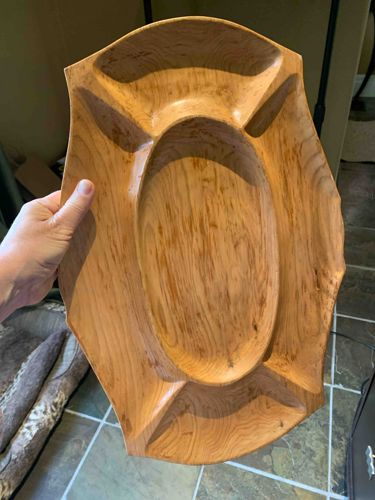
This item is a handcrafted wooden serving tray or relish dish, likely carved from a single piece of light-colored hardwood, possibly maple, oak, or a fruitwood, given its fine grain and honey-toned hue with subtle reddish undertones. The overall shape is an organic, irregular rectangle with undulating, slightly flared edges, giving it a somewhat biomorphic or naturalistic aesthetic. It features a central, elongated oval-shaped well, surrounded by four smaller, kidney-bean-shaped compartments at each corner. These compartments are smoothly scooped out, indicating skilled craftsmanship in carving and shaping. The surface exhibits a satin to semi-gloss finish, which highlights the wood's natural grain patterns—visible as intricate lines and subtle rings across the piece. There are no obvious signs of significant damage such as cracks, chips, or deep scratches, suggesting it has been well-maintained or is relatively new. The edges are smoothly rounded, contributing to the tactile appeal and safe handling. The underside is not visible, so details on manufacturing marks, feet, or additional finishes are unknown. The 'AHPIN signature' context provided suggests this may be a piece by a specific artisan or studio, which would add significant value if confirmed by a visible signature or mark on the item. Given its form and finish, it appears to be of modern craftsmanship, possibly from the mid-20th century onwards, aligning with styles that emphasize natural materials and organic forms. The quality of the carving and the smooth finish indicate good craftsmanship, designed for both aesthetic appeal and practical use in serving appetizers, nuts, candies, or relishes.
AI Appraisal Report
Based on my examination of the provided images and description, this is a very well-crafted, handcrafted wooden compartmented serving tray. The piece is carved from what appears to be a single block of high-quality, light-colored hardwood, possibly maple or a fruitwood, exhibiting a fine grain and an attractive satin finish that highlights its natural beauty. The design is organic and modern, reminiscent of mid-century aesthetics that favor natural materials and biomorphic forms. The five smoothly scooped compartments indicate skilled artisanship. The overall condition appears excellent, with no visible cracks, chips, or significant wear.
The most significant factor impacting its value is the 'AHPIN signature'. If this corresponds to a known and collected artisan or studio, the value could be substantial. However, without a clear view of the signature and with limited public information on an artisan named 'AHPIN', its contribution to value is speculative. Current market comparables for similar unsigned, high-quality, hand-carved wooden trays from the mid-2century to contemporary periods typically range from $40 to $100. The superior craftsmanship of this piece places it at the higher end of that range. Rarity is tied to the maker; if 'AHPIN' is a sought-after, low-production artist, the piece is rare. If it's an unknown hobbyist, it is a unique but not necessarily rare item in the market sense.
It is crucial to note the limitations of this appraisal. Without a physical inspection, I cannot confirm the wood species, the quality of the finish, the presence and authenticity of the 'AHPIN' signature, or check for subtle repairs. Verifying the artist's signature through direct comparison with known examples or maker's mark databases would be essential for a definitive valuation.