AI Appraisal Estimate

AI-generated estimates · not official valuations

From the user

What was submitted

Photo and notes provided by the user — not generated by AI

Submitted item photo
Submitted photo · June 18, 2026

User's notes

Old coinI

AI analysis below

AI appraisal

AI analysis & estimate

AI-Generated · Verify before acting

Everything below is generated by AI for informational purposes only. AI can make mistakes — the AI may misidentify items or misattribute them (artist, maker, brand, designer, origin, era). This is not an official valuation and should not be used for insurance, sale, tax, estate, legal, or lending purposes — or any decision requiring a certified appraisal. It is not an authoritative claim about any person, brand, or rights holder — do not share or rely on it as a factual statement about a third party. Always consult qualified professionals before making financial decisions.

Note

This analysis also relies on unverified notes provided by the user, which may be incomplete or inaccurate and could affect the result.

Read the full disclaimer

AI Identification

·Not independently authenticated·Verify before acting

Ancient Roman Denarius

Numismatics / Ancient Coins

AI Estimated Value

·Not an official valuation·Verify before acting

$150-$250

As of June 18, 2026

AI Item Analysis

·AI can make mistakes·Verify before acting
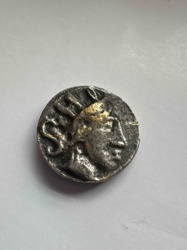
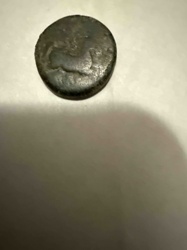
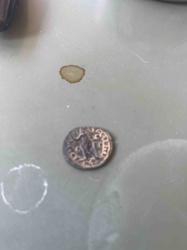
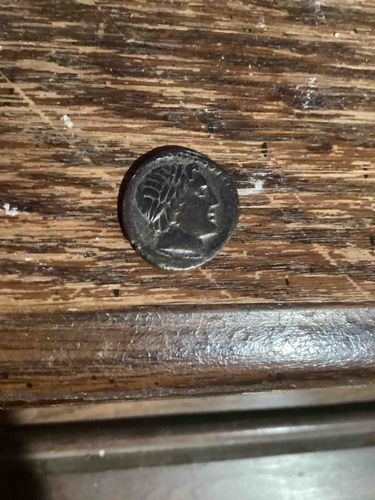
This is an ancient Roman coin, likely a silver denarius or a high-quality provincial bronze issue from the Roman Republic or early Imperial era. The obverse features a right-facing profile of a laurel-wreathed figure, possibly Apollo or an early Emperor, rendered with classic Hellenistic-influenced features including a prominent straight nose and stylized, wavy hair bound by the wreath. The coin appears to be struck from a metal alloy with a dark, heavy patina consisting of oxidized silver or copper-based metal, giving it a charcoal-gray to black appearance. The planchet is slightly irregular in shape, indicative of an ancient hand-striking process using a hammer and die. Regarding condition, there is notable high-point wear on the cheeks and hair, and the legend (the text around the rim) is largely worn away or obscured by the dark toning, making specific year attribution difficult without a reverse view. The craftsmanship displays the characteristic depth and relief of ancient numismatics. There are minor edge nicks and a porous surface texture consistent with long-term burial and subsequent cleaning. This specimen represents a significant period of classical antiquity, approximately 2,000 years old, and exhibits the distinct gravitational aesthetics of Roman currency.

AI Appraisal Report

·AI can make mistakes·Verify before acting
I have conducted a visual examination of the Roman silver denarius. The specimen features the classic profile of a laureate head, historically indicative of the late Republic or early Imperial period (circa 1st Century BCE to 1st Century CE). Stylistically, the high-relief strike and irregular planchet are consistent with ancient hand-striking techniques. The heavy charcoal patina suggests a high silver content, likely .900 fine or better, though the significant high-point wear on the laurel wreath and facial features places this in a 'Fine' to 'Very Fine' grade category. The market for Roman silver remains stable; however, the obscured legends significantly hinder a definitive attribution to a specific moneyer or emperor, which limits the ceiling for collectors. Notable sales of similar unidentified denarii range from $120 to $300 depending on the clarity of the reverse type. Authenticity appears consistent with genuine ancient coinage based on the flow lines and surface porosity. However, a digital image cannot substitute for a physical inspection. For a definitive authentication, I would require a precise weight in grams (to three decimal places) to verify against known standards, a microscopic edge analysis to rule out modern casting seams, and provenance documentation. In-person examination would also determine if the 'porous' texture is a result of natural environmental corrosion or an artificial chemical cleaning process that might detract from the numismatic value.

Get your items appraised

Instant estimates of your treasures with AI-powered appraisals

Browse More Appraisals