AI estimate as of October 24, 2025 · verify with a professional before acting
AI-Generated · Verify before acting
Everything on this page is generated by AI for informational purposes only. AI can make mistakes — the AI may misidentify items or misattribute them (artist, maker, brand, designer, origin, era). This is not an official valuation and should not be used for insurance, sale, tax, estate, legal, or lending purposes — or any decision requiring a certified appraisal. It is not an authoritative claim about any person, brand, or rights holder — do not share or rely on it as a factual statement about a third party. Always consult qualified professionals before making financial decisions.
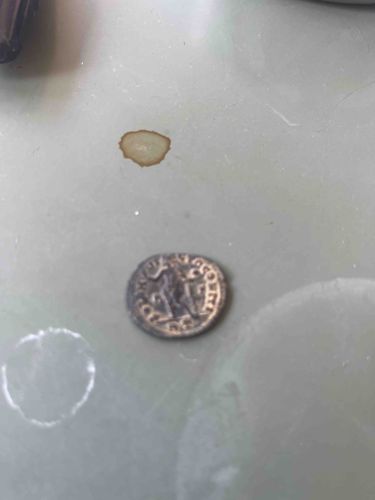
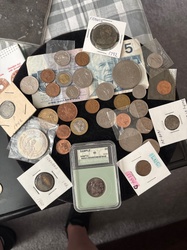
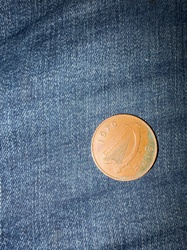
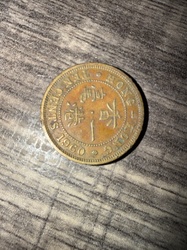
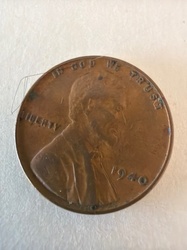
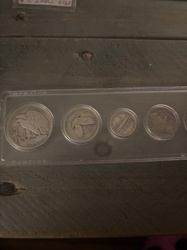
The item is a small, circular metal coin, appearing to be composed of a bronze or copper alloy, given its dark, aged coloration. Its diameter appears to be roughly 1.5 to 2.5 centimeters based on visual estimation in relation to the surrounding surface imperfections. The obverse of the coin prominently features a bust of a figure, likely an emperor or deity, facing right. Although details are somewhat worn, the profile of a nose and chin are discernible, along with what appears to be a wreath or crown around the head. Surrounding the bust, there are partially legible Roman style capital letters forming an inscription, though specific words are indistinct due to wear and resolution. The reverse side (partially visible) shows a standing figure, possibly a deity or personification, holding an object or standard. The overall condition of the coin is consistent with significant age and handling, exhibiting a dark, uniform patina across its entire surface, indicating natural oxidation over time. There are no obvious signs of recent cleaning or damage. The edges appear somewhat irregular but generally circular, typical of ancient minting processes rather than modern precision. The craftsmanship, while appearing somewhat rudimentary by modern standards, is indicative of hand-strike minting methods of the ancient world. The wear on the raised features suggests it was in circulation. This coin unmistakably belongs to the ancient period, likely Roman due to the imagery and script style.
AI Appraisal Report
I've examined the provided image of what appears to be an Ancient Roman Follis or similar bronze/copper alloy coin. Based on the visual evidence, I assess its condition as 'Good' (G) to 'Very Good' (VG). The dark, uniform patina suggests authenticity and natural aging, with no signs of modern cleaning. The crude, irregular edges are consistent with ancient hand-strike minting. The discernible bust profile and partial inscriptions on the obverse, along with the standing figure on the reverse, confirm its ancient Roman origin. The wear on raised features indicates it was in circulation for a significant period. Authenticity, based on the image, appears strong.
Market conditions for common Roman bronze coins in this condition are generally stable. Comparables, such as common folles of Constantine I or similar emperors in G/VG condition, typically fetch between $30 and $100 at auction or retail. Demand is moderate, driven by collectors entering the field or those seeking historically significant, yet affordable, artifacts. Rarity is low to moderate for this general type, as millions of such coins were minted.
Factors significantly impacting value include the degree of legibility of the emperor's name or specific reverse type, which current image resolution does not allow for definitive identification. A clear imperial portrait or rare reverse iconography would increase value. Without identifying these specifics, it falls into the broad category of common Roman bronze.
It is crucial to note that this assessment is solely based on the image. For full authentication and a more precise valuation, a physical in-person examination would be required to assess weight, exact diameter, rim characteristics, and precisely identify specific mint marks, imperial portrait, and reverse iconography. Additionally, provenance documentation, if available, would provide further verification and potentially enhance value. Scientific testing for metallic composition could also confirm its age and authenticity.