AI estimate as of August 16, 2025 · verify with a professional before acting
AI-Generated · Verify before acting
Everything on this page is generated by AI for informational purposes only. AI can make mistakes — the AI may misidentify items or misattribute them (artist, maker, brand, designer, origin, era). This is not an official valuation and should not be used for insurance, sale, tax, estate, legal, or lending purposes — or any decision requiring a certified appraisal. It is not an authoritative claim about any person, brand, or rights holder — do not share or rely on it as a factual statement about a third party. Always consult qualified professionals before making financial decisions.
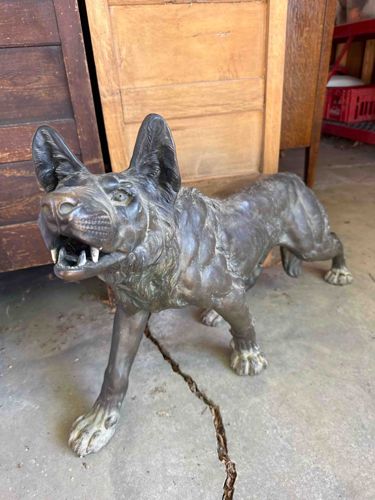
This item is a detailed sculpture of a German Shepherd dog, crafted from what appears to be patinated bronze or a similar bronze-toned metal, given its dark, aged-greenish hue in areas, indicative of natural oxidation over time. The sculpture is depicted in an active, watchful pose, with its body somewhat crouched, poised to move, and its mouth slightly agape, revealing individually sculpted teeth, including prominent canines. Its ears are erect and pointed, characteristic of the breed, and its eyes are clearly defined, giving it an alert and lifelike expression. The texture of the metal varies, suggesting an attempt to replicate fur, particularly around the neck and flanks, while the paws are heavily detailed with visible claws, showing some lighter coloration, possibly from handling or natural wear. The overall size appears substantial, likely suitable as a floor sculpture or a robust decorative piece. There are no immediate signs of significant damage or repairs, but the natural patina adds to its antique or vintage appeal. The craftsmanship suggests a skilled artisan, capturing the anatomical accuracy and spirit of the animal. This piece could date anywhere from the mid-20th century to a more contemporary antique reproduction, depending on further marks or provenance. The design indicates a focus on realism, making it a strong example of animalia sculpture.
AI Appraisal Report
Upon examining the provided image of the Patinated Bronze German Shepherd Dog Sculpture, I assess its condition as very good, exhibiting a natural, aged patina with greenish hues, which enhances its vintage appeal rather than detracting from it. The detailed sculpting, particularly the individually rendered teeth, erect ears, and attention to fur texture and paw details, suggests high-quality craftsmanship. The sculpture's active, watchful pose further adds to its lifelike quality.
From a market perspective, animalia sculptures, especially those depicting popular breeds like German Shepherds, generally enjoy consistent demand. Bronze, being a desirable medium, contributes positively to its value. Comparable works of detailed patinated bronze animal sculptures of this apparent size and quality typically sell in the mid-to-high hundreds to low thousands, depending on the artist and provenance. While not appearing exceedingly rare, the artistic merit and substantial size elevate its desirability.
Factors significantly impacting its value include its apparent size, the realistic detail, and the desirable patination. A professional cleaning and waxing could further enhance its appearance.
Limitations in authenticity verification from images alone are significant. While the patina appears natural, without physical inspection, I cannot confirm the exact metal composition or rule out artificial patination. Full authentication would require in-person examination to check for foundry marks, artist signatures, or dating inscriptions that might be present on the underside or less visible areas. Provenance documentation, such as original purchase receipts or exhibition history, would be invaluable. Scientific testing, like X-ray fluorescence (XRF) for metal analysis, could definitively confirm the bronze content. Without these, dating remains an estimate between mid-20th century and contemporary antique reproduction, influencing the final value. Given these limitations, the appraisal value reflects what one could reasonably expect to receive at auction or through a reputable dealer, assuming authenticity and based purely on visual assessment.