AI estimate as of August 13, 2025 · verify with a professional before acting
AI-Generated · Verify before acting
Everything on this page is generated by AI for informational purposes only. AI can make mistakes — the AI may misidentify items or misattribute them (artist, maker, brand, designer, origin, era). This is not an official valuation and should not be used for insurance, sale, tax, estate, legal, or lending purposes — or any decision requiring a certified appraisal. It is not an authoritative claim about any person, brand, or rights holder — do not share or rely on it as a factual statement about a third party. Always consult qualified professionals before making financial decisions.
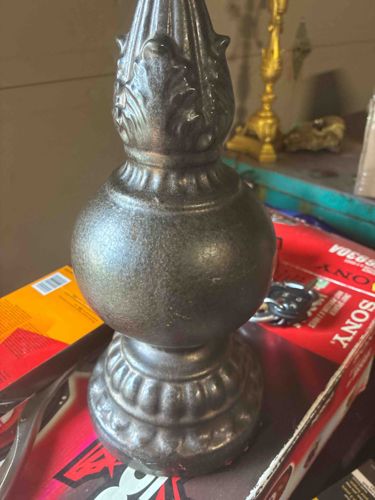
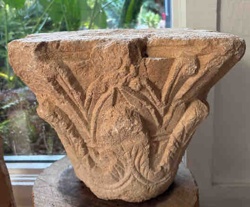
The item appears to be a metal finial, likely made of cast iron or a similar heavy metal, with a weathered antiqued bronze or dark gray finish. It features a prominent spherical body, approximately the size of a large grapefruit, gracefully transition to a decorative base and an elongated, spired top section. The finish exhibits a textured, slightly mottled appearance, suggesting either intentional antiquing or natural patina from age and exposure. There are no obvious signs of significant damage like cracks or chips, though minor scuffs or subtle abrasions might be present given the textured surface. The base has a fluted or scalloped design, providing a stable foundation, while the top portion is adorned with intricate foliage-like carvings resembling acanthus leaves, culminating in a pointed, almost flame-like tip. The craftsmanship indicates a molded or cast production, with attention to decorative detail, typical of architectural or furniture embellishments from the late 19th to mid-20th century, drawing inspiration from classical or Victorian styles. There are no visible maker's marks or signatures in the provided image. Its solid construction suggests it was designed to be a permanent fixture, possibly as a newel post cap, a fence post topper, or a decorative element on a lamp or piece of furniture. The overall condition appears consistent with an item that has seen some use but is well-preserved, with the finish contributing to its aged aesthetic.
AI Appraisal Report
Upon visual examination of the provided image, I assess this Cast Metal Decorative Finial to be in good, stable condition. The antiqued bronze/dark gray finish appears consistent with appropriate aging for a piece of this type, effectively masking any minor surface irregularities that might be present. There are no apparent cracks, bends, or significant losses to the metal, suggesting solid integrity. While the craftsmanship points to a molded or cast production, typical of late 19th to mid-20th century architectural or furniture embellishments, I cannot definitively confirm authenticity or specific age based on images alone. An in-person examination would allow for tactile inspection of the metal's texture, weight, and subtle surface characteristics, which can reveal casting techniques and material composition. The absence of visible maker's marks is common for such utilitarian decorative elements, but hinders attribution. Provenance documentation, if available, would be crucial for verifying its historical context and origin. Further metallurgical testing could confirm the exact alloy and potentially narrow down its period of manufacture.
In terms of market conditions, architectural salvage and decorative hardware are consistently sought after by collectors, restorers, and designers. Pieces with classical or Victorian motifs, like this finial with its acanthus leaf design, generally maintain steady demand. While decorative finials are not exceedingly rare, a well-preserved example with appealing aesthetics such as this holds value. Its size and solid construction suggest it was likely a prominent feature, possibly a newel post cap or a gate finial. Factors that positively impact its value include its good condition, appealing design, and perceived vintage age. Limitations in determining true age and origin without physical inspection or provenance prevent a higher valuation typically associated with unequivocally antique or rare pieces with documented history.