These notes were written by the person who submitted this item. Appraiser.AI has not verified them, and the AI's identification and estimate may rely on them.
AI Estimated Value
Not an official valuation
$1,500 - $2,500
AI estimate as of August 19, 2025 · verify with a professional before acting
AI-Generated · Verify before acting
Everything on this page is generated by AI for informational purposes only. AI can make mistakes — the AI may misidentify items or misattribute them (artist, maker, brand, designer, origin, era). This is not an official valuation and should not be used for insurance, sale, tax, estate, legal, or lending purposes — or any decision requiring a certified appraisal. It is not an authoritative claim about any person, brand, or rights holder — do not share or rely on it as a factual statement about a third party. Always consult qualified professionals before making financial decisions.
This analysis also relies on unverified notes provided by the user, which may be incomplete or inaccurate and could affect the result.
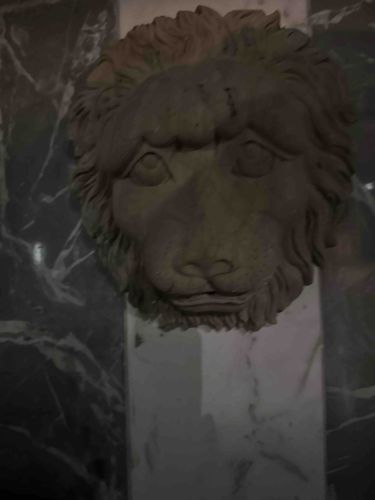
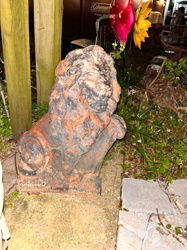
This appears to be an antique architectural ornament depicting the head of a lion, likely carved from a natural stone such as sand stone or a similar composite material given its earthen color and textured surface. The lion's head is rendered with stylized hair forming a prominent mane around its face, which exhibits carved details for the eyes, nose, and mouth. The eyes are depicted with a somewhat wide, almost human-like gaze, and the mane shows individual strands and curls that suggest a degree of fine craftsmanship. The color is predominantly a muted, dusty brown or grey, consistent with aged stone or terracotta. There are visible signs of aging and wear, including what appears to be dirt accumulation or patination, particularly in the crevices of the mane and around the facial features. A dark, possibly water or stain mark, is noticeable near the top of the forehead. The piece is mounted on or integrated into a dark, veined marble or stone surface, suggesting it was part of a larger architectural feature like a column capital, frieze, or wall adornment. The craftsmanship indicates a classical or neoclassical influence, evident in the detailed yet somewhat idealized portrayal of the lion. Its substantial size, given its context next to a column, points to its use in a grander architectural setting rather than a small decorative object. The condition suggests it has been exposed to elements, contributing to its antiqued appearance. Its robust construction and carving details reflect a quality typical of architectural elements from an earlier period, possibly 19th or early 20th century.
AI Appraisal Report
Based on my visual examination of the provided images, this antique lion head architectural ornament appears to be carved from natural stone, likely sandstone, or a similar composite material, consistent with its earthen color and textured surface. The detailed rendering of the mane and facial features, including the somewhat wide, human-like gaze, suggests a classical or neoclassical influence. Its substantial size, implied by its context next to a column, points to use in a grander architectural setting rather than a small decorative object.
The condition shows clear signs of age and exposure, including dirt accumulation, patination in crevices, and a notable dark stain near the forehead. This wear is consistent with its probable outdoor architectural use and contributes to its authentic antique appearance. The robust construction and carving details align with architectural elements from the 19th or early 20th century.
In terms of market conditions, architectural salvage and garden elements with historical significance currently have a steady demand, especially pieces with intricate carving like this. Comparable items, often found in specialized antique architectural salvage dealers or auctions, can vary widely in price based on material, size, craftsmanship, and state of preservation. The rarity of an intact, well-carved piece of this scale enhances its appeal.
Factors significantly impacting value include its age, perceived material (natural stone increases value), the quality of carving, and its impressive scale. The current condition, while showing wear, is acceptable for an antique architectural piece, as it evidences its history.
It is crucial to note the limitations of assessing authenticity from images alone. A definitive authentication would require an in-person examination to assess the material properties, carving techniques, and patina firsthand. Furthermore, provenance documentation detailing its origin and history would be invaluable. Scientific testing, such as elemental analysis of the stone, could confirm its age and composition, providing irrefutable evidence of authenticity.