AI estimate as of September 18, 2025 · verify with a professional before acting
AI-Generated · Verify before acting
Everything on this page is generated by AI for informational purposes only. AI can make mistakes — the AI may misidentify items or misattribute them (artist, maker, brand, designer, origin, era). This is not an official valuation and should not be used for insurance, sale, tax, estate, legal, or lending purposes — or any decision requiring a certified appraisal. It is not an authoritative claim about any person, brand, or rights holder — do not share or rely on it as a factual statement about a third party. Always consult qualified professionals before making financial decisions.
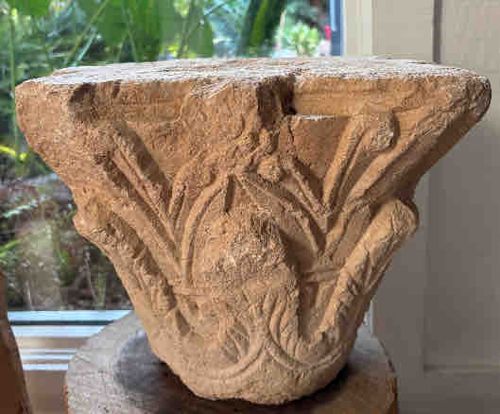
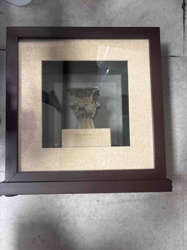
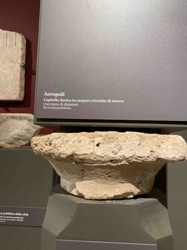
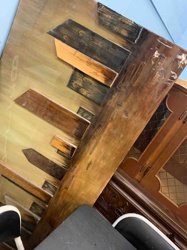
This is a carved architectural fragment, specifically appearing to be the capital of a column, likely Corbeled or similarly decorative. It is crafted from a light brownish-beige stone, possibly sandstone or a similar sedimentary rock due to its granular texture and 'weathered', softened appearance. The capital exhibits a classic bell-shaped profile, tapering downwards, and features intricate relief carving characteristic of ancient or medieval architectural ornamentation. The primary motif consists of stylized acanthus leaves, rendered in a somewhat flattened, bold manner that suggests a Romanesque or Byzantine influence, though it could also be a simplified rendition of classical Corinthian or composite styles. The leaves are arranged in tiers, with volutes or tendrils emerging from the upper register, culminating in small, indistinct elements that might represent flower buds or scrolls. The top surface of the capital is flat and rough, suggesting it once supported another architectural element, possibly a lintel or an architrave. The stone displays significant wear and erosion consistent with prolonged exposure to the elements and age, indicated by the softened edges of the carvings, surface abrasions, and a generally dull, aged patina. There are visible chips and losses, particularly along the top edge and parts of the carved details, which contribute to its antique character. Despite the wear, the craftsmanship of the carving is evident, demonstrating a skilled hand in shaping the stone and creating the decorative patterns. There are no discernible maker's marks or signatures visible from the provided image. The overall aesthetic points to an object of considerable age, possibly dating from the early medieval period to the more recent past depending on the specific stylistic interpretation. Its solidity and material suggest it was part of a substantial building structure.
AI Appraisal Report
Based on my visual examination of the provided image, this carved stone architectural fragment, identified as a column capital, appears to be an authentic antique piece. The light brownish-beige stone, likely sandstone, exhibits granular texture and significant 'weathering,' consistent with considerable age and exposure. The bell-shaped profile with stylized acanthus leaves arranged in tiers and emerging volutes suggests a Romanesque or Byzantine influence, or a simplified classical style. The craftsmanship, despite wear, indicates a skilled artisan. Its condition shows significant wear, erosion, softened edges, and chips, all contributing to an authentic antique patina rather than suggesting recent damage. These characteristics are desirable in the collector market for architectural salvage.
Market conditions for genuine antique architectural fragments are generally stable, with demand for well-preserved examples from significant periods. Comparables often include similar capitals found in architectural salvage galleries or specialized antique dealers, particularly those with a demonstrable historical provenance. Pieces with clear stylistic attribution and good condition typically fetch higher prices. This capital's aesthetic appeal and evidence of age contribute positively to its marketability.
Factors significantly impacting value include its age, artistic merit, and the material. The current state of wear is acceptable for an artifact of this type and does not detract significantly, rather it enhances its historical character. Rarity is moderate; while many such capitals exist, each has unique characteristics.
My primary limitation in determining a definitive authenticity and precise age is the reliance on images alone. For full authentication and a more precise dating, an in-person examination would be critical. This would allow for tactile assessment of the stone, detailed inspection of carving techniques not fully discernible from photographs, and microscopic analysis to verify stone type and identify any mineralogical changes due to age. Additionally, any provenance documentation, such as historical records of the building it originated from, is crucial for both authenticity and value. Without such documentation or in-person inspection, the estimate remains an informed assessment based purely on visual cues.