These notes were written by the person who submitted this item. Appraiser.AI has not verified them, and the AI's identification and estimate may rely on them.
AI Estimated Value
Not an official valuation
$1,200 - $2,500
AI estimate as of October 7, 2026 · verify with a professional before acting
AI-Generated · Verify before acting
Everything on this page is generated by AI for informational purposes only. AI can make mistakes — the AI may misidentify items or misattribute them (artist, maker, brand, designer, origin, era). This is not an official valuation and should not be used for insurance, sale, tax, estate, legal, or lending purposes — or any decision requiring a certified appraisal. It is not an authoritative claim about any person, brand, or rights holder — do not share or rely on it as a factual statement about a third party. Always consult qualified professionals before making financial decisions.
This analysis also relies on unverified notes provided by the user, which may be incomplete or inaccurate and could affect the result.
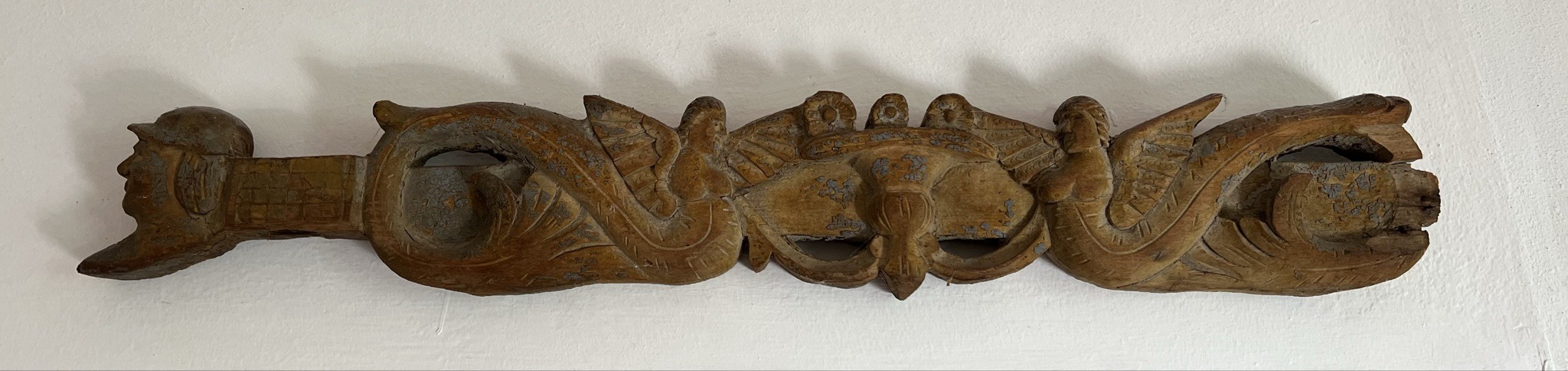
This object is a long, horizontally oriented carved wooden architectural element or frieze, presented against a plain white background. The piece is constructed from a solid block of hardwood, exhibiting a warm brown tone with significant aged patina. The surface shows visible traces of old, flaking paint or gesso, particularly in the recessed areas and around the carved details. The carving is deeply relief-cut and features a symmetrical or repeating decorative composition. On the far left end, there is a distinct carved profile head wearing a helmet or cap, followed by a grid-like or block pattern resembling masonry or a bolster. Moving toward the center, the design incorporates scrolling vegetal or serpentine forms flanking winged figures or sirens that support a central heraldic motif, crown-like ornament, or central cartouche. The right end mirrors the scrolling, organic motifs and shows rough, unrefined termination or damage indicating it was likely once part of a larger, continuous architectural installation. There are no visible maker's marks, stamps, or signatures present on the surface. The overall craftsmanship, deeply carved figural and scroll motifs, and distressed surface condition suggest a stylistic compatibility with European architectural fragments, possibly dating from the historical or antique periods, though the exact age and origin remain unverified. The user has provided context indicating it is a wooden manufactured piece, but this claim is entirely unverified by visual inspection alone. The identification of this object is based purely on its observed physical characteristics, material composition, and sculptural style.
AI Appraisal Report
Based on the visual evidence provided, I can observe a long, horizontally oriented carved wooden architectural frieze featuring deeply relief-cut scrolling vegetal motifs, figural elements, and a helmeted profile head. The piece exhibits a warm brown tone with a significant aged patina and visible traces of flaking paint or gesso in the recessed areas. However, based on a photo alone, I cannot verify the exact age, wood species, or structural integrity, and physical inspection would be required to confirm these factors. Per user submission, this is claimed to be a wooden manufactured piece, though this attribution remains unverified. The estimated value range of $1,200 to $2,500 assumes that the item is a period European architectural fragment consistent with its stylistic appearance. General market demand for antique architectural salvage and carved wood elements is driven by decorative appeal and interior design applications, where fragments of this type typically command moderate to high interest among collectors and designers. If this item turns out to be a later reproduction, replica, copy, or produced 'in the style of' rather than a period piece, the value would decrease substantially, likely falling into the $200 to $500 range. To confirm authenticity and refine this estimate, an in-person examination by a qualified expert, detailed provenance documentation, and potential scientific testing such as wood dating analysis would be necessary.