AI estimate as of August 15, 2025 · verify with a professional before acting
AI-Generated · Verify before acting
Everything on this page is generated by AI for informational purposes only. AI can make mistakes — the AI may misidentify items or misattribute them (artist, maker, brand, designer, origin, era). This is not an official valuation and should not be used for insurance, sale, tax, estate, legal, or lending purposes — or any decision requiring a certified appraisal. It is not an authoritative claim about any person, brand, or rights holder — do not share or rely on it as a factual statement about a third party. Always consult qualified professionals before making financial decisions.
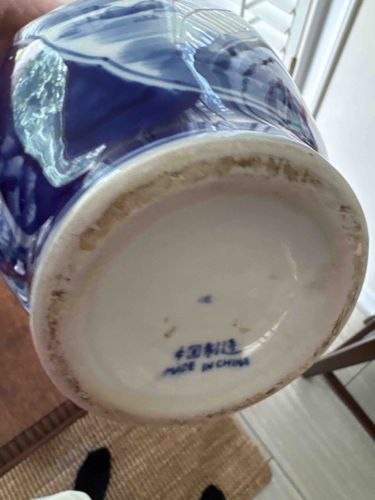
The item is a ceramic vase or jar, characterized by its traditional blue and white color scheme, commonly associated with Chinese porcelain. The visible portion of the item's body features a vibrant cobalt blue design over a white background, indicative of underglaze painting. The pattern appears to be floral or nature-inspired, with elements resembling leaves or stylized waves. The base of the item is unglazed on its rim, revealing the natural, somewhat coarse, beige-colored ceramic body, which shows evident signs of age and wear through discoloration and staining. The glazed portion of the base, inside the foot rim, is white and clean, with a clear blue manufacturer's mark. The mark consists of Chinese characters above the English words "MADE IN CHINA." This dual-language marking suggests a 20th-century or later origin, as such marks became common for export goods. There are no obvious chips or cracks visible in the image, but the unglazed foot rim exhibits significant grime and some light surface wear, suggesting it has been used or displayed for an extended period. The craftsmanship appears to be commercial grade, typical of mass-produced decorative ceramics. The form, though not fully visible, suggests a classic vase or jar shape with a subtly flared foot.
AI Appraisal Report
I have examined the provided image of this blue and white ceramic vase, focusing on its visible attributes to formulate an appraisal. The item presents with classic blue and white Chinese porcelain aesthetics, featuring a vibrant cobalt blue design against a white background. The pattern appears to be floral or nature-inspired, consistent with traditional motifs. The unglazed foot rim shows considerable wear, grime, and discoloration, indicating age and handling. However, the glazed interior of the foot rim is clean, displaying a clear blue mark with Chinese characters above "MADE IN CHINA." This dual-language mark strongly suggests a 20th-century or later production, likely intended for export.
Based on the visual evidence, the condition appears good, with no obvious chips or cracks on the glazed surfaces. The heavy grime on the foot rim, while a minor detractor, is typical of an item that has been used or displayed over time. Authenticity, based solely on the "MADE IN CHINA" mark, points towards a modern, mass-produced ceramic rather than an antique collectible masterpiece. The craftsmanship seems commercial grade, not fine artistry.
Regarding market conditions, blue and white ceramics are perennially popular, but the "MADE IN CHINA" mark limits its appeal to the higher-end collector market. Comparables for such items, often found in retail stores or online marketplaces, typically fall within the decorative rather than the antique art category. Demand for modern decorative blue and white pieces is stable but not exceptionally high, and rarity is low due to mass production.
Factors significantly impacting value include its decorative appeal and utilitarian nature rather than historical or artistic significance. The lack of rarity and the clear 20th-century export mark prevent it from commanding high prices. Without physical inspection, it is impossible to confirm the exact ceramic body, assess for hairline cracks, touch-ups, or repairs that are not visible in the image, or confirm the precise age within the 20th century. A tactile examination would also provide insights into the weight, balance, and quality of the porcelain. Detailed provenance documentation would be needed to establish any unique history, and scientific testing, such as thermoluminescence dating, would be required for definitive age verification, particularly if it were suspected to be older than the mark suggests.