AI estimate as of October 11, 2025 · verify with a professional before acting
AI-Generated · Verify before acting
Everything on this page is generated by AI for informational purposes only. AI can make mistakes — the AI may misidentify items or misattribute them (artist, maker, brand, designer, origin, era). This is not an official valuation and should not be used for insurance, sale, tax, estate, legal, or lending purposes — or any decision requiring a certified appraisal. It is not an authoritative claim about any person, brand, or rights holder — do not share or rely on it as a factual statement about a third party. Always consult qualified professionals before making financial decisions.
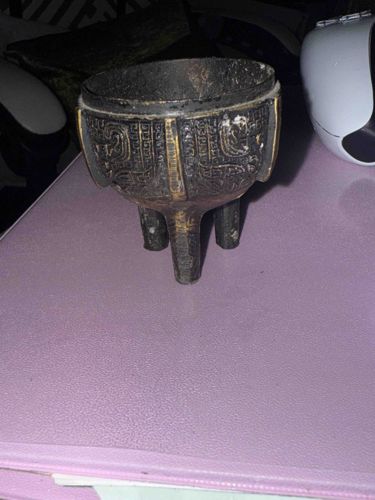
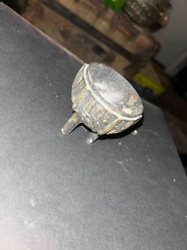
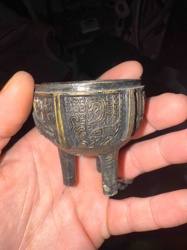
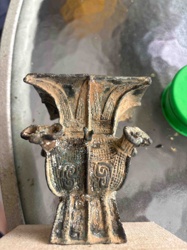
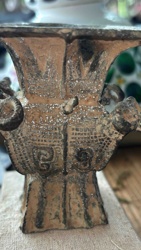
This item is a small, tripod bronze vessel, likely a decorative reproduction inspired by ancient Chinese ding vessels. It has a squat, cylindrical body with a slightly flaring rim and stands on three robust, tapered legs. The primary material appears to be bronzed metal, exhibiting a dark, aged patina with areas of exposed lighter, yellowish-gold metal, suggesting a layered finish or intentional highlighting. The exterior of the vessel is heavily decorated with intricate, raised relief patterns. These patterns evoke archaic beast motifs (Taotie masks) and geometric designs, common in ancient Chinese bronzework. Vertical raised panels with similar decoration punctuate the body, further defining its structure. The craftsmanship, while detailed, shows a level of casting that suggests it might be a more modern commemorative or decorative piece rather than an authentic ancient artifact. The surface is textured with general wear and some scuffing, particularly on the legs and rim. There are no obvious signs of significant damage or repairs, but the aged finish contributes to its aesthetic. Its small size suggests it could be a display piece, an incense burner, or a brush pot, rather than a functional cooking or ritual vessel from antiquity. The style period emulated is characteristic of the Shang or Zhou dynasties, known for their elaborate bronze ritual vessels.
AI Appraisal Report
Upon visual examination of the provided image, I assess this tripod bronze vessel to be a decorative reproduction inspired by ancient Chinese ding vessels, likely exhibiting a bronzed metal finish rather than solid bronze. The dark, aged patina with exposed yellowish-gold metal suggests a manufactured finish designed to mimic antiquity. The intricate raised relief patterns, while detailed and evoking archaic beast motifs (Taotie masks) and geometric designs characteristic of Shang or Zhou dynasties, show a level of casting that strongly indicates modern production rather than an authentic ancient artifact. The overall craftsmanship, while decorative, lacks the nuanced irregularities and specific patination associated with genuine archaeological finds.
Its condition appears good, with expected wear, scuffing on the legs and rim, and no obvious signs of significant damage or repairs. This wear contributes to its decorative appeal rather than detracting from it, considering its likely modern origin.
From a market perspective, decorative reproductions of ancient Chinese bronzes are relatively common. Demand is modest, typically from individuals seeking aesthetic display pieces. Rarity is low due to the probable modern manufacturing. Comparable items often sell in the range provided, reflecting their decorative rather than historical value. Factors impacting this value include the quality of the casting, the convincingness of the aged finish, and overall aesthetic appeal. Without physical inspection, I cannot definitively confirm the base metal composition (e.g., spelter, cast iron with bronze plating). An in-person examination would allow for closer inspection of surface texture, weight, and potentially a scratch test in an inconspicuous area for metal identification. Full authentication as an ancient artifact would necessitate professional scientific testing (e.g., XRF analysis, metallography), provenance documentation, and expert conservation review. Based on the visual evidence, I am confident in appraising it as a decorative contemporary piece.