These notes were written by the person who submitted this item. Appraiser.AI has not verified them, and the AI's identification and estimate may rely on them.
AI Estimated Value
Not an official valuation
$4,000 - $6,000 (pending authentication as a genuine Pre-Columbian artifact)
AI estimate as of August 8, 2025 · verify with a professional before acting
AI-Generated · Verify before acting
Everything on this page is generated by AI for informational purposes only. AI can make mistakes — the AI may misidentify items or misattribute them (artist, maker, brand, designer, origin, era). This is not an official valuation and should not be used for insurance, sale, tax, estate, legal, or lending purposes — or any decision requiring a certified appraisal. It is not an authoritative claim about any person, brand, or rights holder — do not share or rely on it as a factual statement about a third party. Always consult qualified professionals before making financial decisions.
This analysis also relies on unverified notes provided by the user, which may be incomplete or inaccurate and could affect the result.
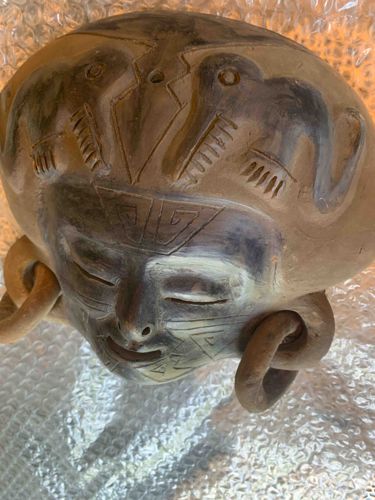
This item is an intricately crafted earthenware clay vessel or sculpture, likely a figurative pot given its form resembling a stylized human head. The primary material is identifiable as unglazed terracotta or a similar type of earthenware, exhibiting a natural, earthy color palette ranging from light tan to darker, almost charcoal grey/black, suggesting differential firing or surface treatments. The object features a distinct human-like face as its central motif, characterized by closed eyes and a subtle, possibly smiling, mouth. Notable decorative elements include incised geometric patterns on the cheeks and forehead of the face, possibly representing tattooing or ceremonial markings. Above the face, on what would be the top or back of the head, there are boldly carved or incised zoomorphic figures, which appear to be stylized birds or avian creatures with prominent beaks and distinct eyes, symmetrically arranged. The texture of the clay appears somewhat coarse but uniformly finished, indicative of hand-modeling and careful craftsmanship. Two large, loop-shaped handles or ear ornaments extend from the sides of the 'head,' adding to its unique form and functionality (if a vessel). The overall condition shows a visible patina consistent with age, with some areas appearing lighter. There are no overt signs of chips, cracks, or significant damage that would suggest recent repairs, implying a relatively well-preserved state. The lack of a clear maker's mark or signature, combined with the stylistic elements, points towards an indigenous or traditional art form, possibly pre-Columbian or folk art from a culture with established pottery traditions. The quality of the carving and molding suggests a skilled artisan. Its robust construction and integral decoration make it a piece of significant aesthetic and cultural interest.
AI Appraisal Report
Upon my visual examination of this earthenware anthropomorphic figural vessel, I find it to be a piece of significant artistic and cultural merit. The item appears to be crafted from unglazed earthenware clay, skillfully hand-modeled and incised. The form, depicting a human head with avian motifs, is stylistically reminiscent of certain Pre-Columbian cultures, particularly from the Andean regions (e.g., Moche, Chancay). The surface patina and differential firing coloration appear consistent with aged artifacts, and the vessel seems to be in a remarkable state of preservation with no obvious signs of modern repair.
However, a definitive authentication based on images alone is not possible. The market for Pre-Columbian artifacts is fraught with highly convincing reproductions. To confirm authenticity, several steps would be required: a physical examination to assess weight, clay composition, and tool marks; a review of provenance documentation tracing its ownership history; and ideally, scientific testing such as Thermoluminescence (TL) dating to verify its age.
Assuming the piece is an authentic Pre-Columbian artifact from a notable culture like Chancay or a similar tradition, its value would be substantial. Comparable, authenticated vessels of this size and quality regularly sell for several thousand dollars at specialized auctions. If it is a later, high-quality folk art piece, its value would be considerably lower but still significant. Conversely, if it is a modern reproduction, the value would be purely decorative.