These notes were written by the person who submitted this item. Appraiser.AI has not verified them, and the AI's identification and estimate may rely on them.
AI Estimated Value
Not an official valuation
$3,000 - $5,000
AI estimate as of August 16, 2025 · verify with a professional before acting
AI-Generated · Verify before acting
Everything on this page is generated by AI for informational purposes only. AI can make mistakes — the AI may misidentify items or misattribute them (artist, maker, brand, designer, origin, era). This is not an official valuation and should not be used for insurance, sale, tax, estate, legal, or lending purposes — or any decision requiring a certified appraisal. It is not an authoritative claim about any person, brand, or rights holder — do not share or rely on it as a factual statement about a third party. Always consult qualified professionals before making financial decisions.
This analysis also relies on unverified notes provided by the user, which may be incomplete or inaccurate and could affect the result.
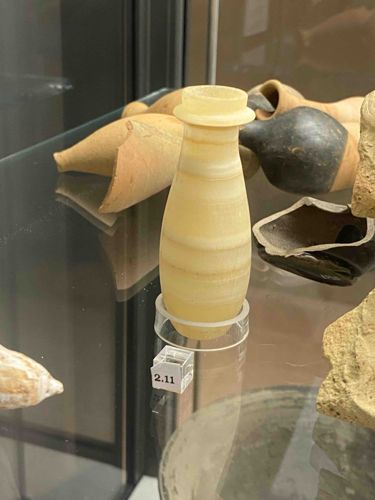
This item is an Alabastron, a small antique vessel, likely used for holding perfumed oil, unguents, or kohl. It is exquisitely crafted from banded alabaster, a translucent, fine-grained variety of gypsum or calcite, which gives it a distinctive appearance. The primary color is a pale, creamy yellow to off-white, with prominent horizontal banding in varying shades of light brown and cream, indicating the natural stratification of the stone. The vessel has an elongated, slender piriform (pear-shaped) body that tapers gently towards a narrow, cylindrical neck and a flat, disc-like rim. The base is slightly flattened, allowing it to stand upright, and it is currently displayed on a modern clear acrylic stand, suggesting it is part of a museum exhibit or collection. The surface appears smooth and polished, reflecting light gently, indicating good craftsmanship in its carving and finishing. There are no immediately visible cracks, chips, or significant repairs, though as an ancient artifact, minor abrasions or patination are likely present, contributing to its authentic character. The alabaster's inherent qualities, such as its translucency and delicate veining, make this a high-quality piece. Its form is characteristic of ancient Mediterranean and Near Eastern perfume or cosmetic containers, suggesting an age spanning from classical antiquity (e.g., Egyptian, Greek, Roman periods). The precise tooling marks are not discernible from the image, but the symmetry and smooth finish point to skilled hand-carving techniques.
AI Appraisal Report
Based on my visual examination of the Alabastron di alabastro, I find it to be a remarkably well-preserved example of an ancient vessel, likely dating from classical antiquity. Its condition appears excellent, with a smooth, polished surface and no immediately visible cracks, significant chips, or repairs, which is impressive for an artifact of this age. The natural banding of the alabaster is striking and enhances its aesthetic appeal. The piriform shape and disc-like rim are characteristic of the period and typical for cosmetic or perfumed oil containers. While the current display on a modern acrylic stand contributes to its presentability, it also suggests it may be from an established collection or museum, which often correlates with good provenance.
From the image alone, authenticating the age conclusively is challenging. Factors such as tool marks, precise wear patterns, and the chemical composition of the alabaster can only be fully assessed through in-person examination. Absence of a discernible repair, however, is a positive; ancient repairs, though sometimes skillful, could affect value. Market conditions for fine ancient artifacts, particularly well-preserved alabaster vessels, are generally strong among collectors of antiquities. Comparables would include similar alabastra from reputable auction houses or galleries. Demand is consistent for high-quality, aesthetically pleasing pieces like this one. Its inherent material beauty and excellent apparent condition positively impact its value. Rarity is moderate, with such pieces appearing periodically on the market.
For full authentication, a physical examination would be crucial to inspect for subtle surface details, patination, and tool marks. Furthermore, provenance documentation (e.g., excavation reports, prior sale records) would significantly enhance its verifiable authenticity and value. Scientific testing, such as elemental analysis or thermoluminescence dating, could provide definitive age confirmation. Without these, my assessment is based on visual characteristics consistent with genuine ancient artifacts of this type.