AI estimate as of July 9, 2025 · verify with a professional before acting
AI-Generated · Verify before acting
Everything on this page is generated by AI for informational purposes only. AI can make mistakes — the AI may misidentify items or misattribute them (artist, maker, brand, designer, origin, era). This is not an official valuation and should not be used for insurance, sale, tax, estate, legal, or lending purposes — or any decision requiring a certified appraisal. It is not an authoritative claim about any person, brand, or rights holder — do not share or rely on it as a factual statement about a third party. Always consult qualified professionals before making financial decisions.
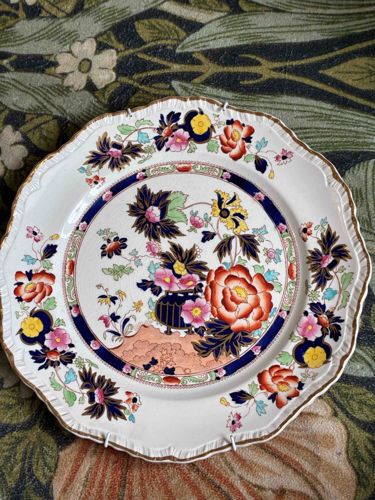
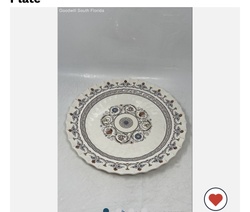
This item is an antique or vintage porcelain dinner plate, likely a dessert or luncheon plate given its general size which appears to be approximately 8-10 inches in diameter. It features a decorative 'Imari' style pattern, characterized by a rich interplay of vivid colors, predominantly cobalt blue, iron red (orange-red), gold, and a variety of secondary accents in pink, light blue, green, and yellow. The central design showcases a floral motif, including large blossoming flowers, smaller blooms, and intricate foliate patterns, arranged around a stylized vase or urn on a peachy-orange ground, all framed within a thick, dark blue circular band. Additional floral and foliate elements, mirroring the central pattern, adorn the wide rim. The plate has a scalloped edge, which adds to its decorative appeal, and this edge is further embellished with a delicate gold gilt rim, showing some signs of wear consistent with age and handling. The white porcelain body serves as a bright canvas for the vibrant overglaze enamels. The plate appears to be in good overall condition for its age, with no immediately visible chips, cracks, or significant repairs, though minor surface wear and some loss to the gold gilt are evident, which is typical for items of this vintage. The intricate details and multi-color palette suggest a high level of craftsmanship. While no specific maker's marks are visible in the provided image, the 'Imari' style was popular among many European and British porcelain manufacturers from the 18th century onwards, particularly in the 19th century, drawing inspiration from Japanese porcelain. Given its aesthetic, it likely dates from the Victorian era or early 20th century.
AI Appraisal Report
Based on my visual examination of the provided image, this Imari-style porcelain dinner plate presents as a charming decorative piece. The condition appears to be good for its age, with the detailed overglaze enamels largely intact, and no immediate signs of chips, cracks, or significant repairs. I do observe the expected minor surface wear and some loss to the gold gilt on the scalloped edge, which is consistent with an antique or vintage item that has seen some handling. These minor imperfections are typical and do not significantly detract from its overall decorative appeal.
Regarding authenticity, the 'Imari' style was widely adopted by European manufacturers. While the quality of the enameling and the intricate design suggest a well-made piece, definitive authentication of origin (e.g., specific European vs. Japanese, or a particular manufacturer) cannot be determined from images alone. A physical examination would allow for inspection of the footrim, base, and any hidden maker's marks or impressed numbers, which are crucial for precise attribution. Provenance documentation, if available, would further solidify its history and origin. Without these, I'm assessing it as a decorative and collectible example of the Imari style, likely Victorian era or early 20th century.
Market conditions for general Imari-style porcelain, particularly unmarked pieces, are stable but not currently experiencing explosive growth. Rarity is difficult to ascertain without knowing the manufacturer and pattern; however, single plates from dinner services are not inherently rare. Comparables for unmarked or generically attributed European Imari-style plates of this size and condition typically range from $40-$80 in retail settings. Supply generally meets demand for such decorative items.
Factors impacting value include its good aesthetic condition, attractive design, and decorative versatility. The primary limitation is the lack of specific attribution, which prevents it from commanding prices associated with desirable manufacturers like Royal Crown Derby, Worcester, or other renowned porcelain houses. Were it identified as such, the value would significantly increase. Should it be part of a larger, complete set, its value would also be higher.
To fully authenticate and achieve a more precise valuation, I would seek to physically examine the plate for maker's marks, impressed numbers, and the quality of the porcelain body. A blacklight test could also reveal hidden repairs.