These notes were written by the person who submitted this item. Appraiser.AI has not verified them, and the AI's identification and estimate may rely on them.
AI Estimated Value
Not an official valuation
$25-45
AI estimate as of September 6, 2025 · verify with a professional before acting
AI-Generated · Verify before acting
Everything on this page is generated by AI for informational purposes only. AI can make mistakes — the AI may misidentify items or misattribute them (artist, maker, brand, designer, origin, era). This is not an official valuation and should not be used for insurance, sale, tax, estate, legal, or lending purposes — or any decision requiring a certified appraisal. It is not an authoritative claim about any person, brand, or rights holder — do not share or rely on it as a factual statement about a third party. Always consult qualified professionals before making financial decisions.
This analysis also relies on unverified notes provided by the user, which may be incomplete or inaccurate and could affect the result.
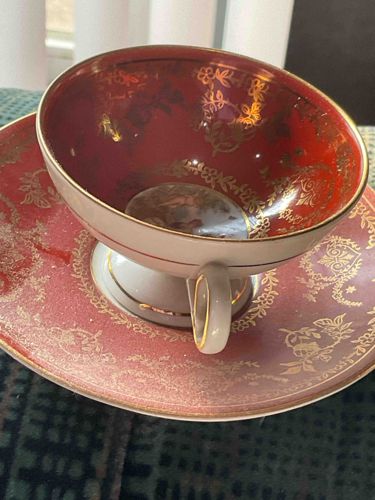
This exquisite teacup and saucer set is crafted from fine porcelain, exhibiting a distinctive color palette and intricate gold gilt decoration. The teacup features a deep, vibrant red interior, contrasting with a creamy ivory or light beige exterior. The red interior is richly adorned with delicate gold floral and scroll motifs, which appear to be applied as a transfer print with additional hand-painted accents for depth and luster. The exterior of the cup is primarily plain, with a thin gold band accenting the rim and a thicker gold line around the base where it meets the stem. The handle is slender, also in the ivory/beige tone, with a gold stripe along its upper edge. The cup is designed with a pedestal base, giving it an elevated and elegant feel, distinct from a typical flat-bottomed teacup. The saucer complements the cup, featuring a graduated color, transitioning from a more intense red at the center to a softer, almost dusty rose or faded red towards the rim. It is heavily decorated with similar gold gilt floral and scroll patterns that cover a significant portion of its surface. A thin gold rim borders the edge of the saucer. The overall craftsmanship suggests a high level of quality, with careful attention to detail in the application of the gilding and the delicate design work. Given the 'BES East Germany' context, this set likely dates from the mid to late 20th century, specifically from the period when East Germany was a separate entity (1949-1990). There are no overt signs of significant damage such as chips or cracks visible in the provided image, but some minor wear to the gold gilt, particularly on the saucer, might be present, consistent with age and use. The surface of the saucer also appears to have some accumulated dust or general patina, which is typical for older decorative items. The design evokes a classic, perhaps Rococo-inspired, aesthetic, often found in European porcelain artistry.
AI Appraisal Report
Upon visual examination of the provided images, this teacup and saucer set, marked 'BES East Germany,' presents as a fine example of mid to late 20th-century German porcelain. The overall condition appears to be very good, with no visible chips, cracks, or crazing. The vibrant red interior and intricate gold gilt decoration are largely intact, although some minor wear to the gilding, consistent with age and gentle use, can be observed on high-contact areas like the saucer's surface and the cup's rim.
The 'BES East Germany' mark confirms its origin and production period (1949-1990). While well-crafted, porcelain from this era is generally not as rare or sought-after by high-end collectors as pieces from earlier, more renowned German manufacturers like Meissen or KPM. The market for East German porcelain is more niche, often appealing to those interested in Cold War-era decorative arts or collectors of specific patterns. Current market comparables for similar East German teacup sets from makers like Graf von Henneberg, Weimar, or Colditz show values typically ranging from $20 to $50, depending on condition and decorative complexity.
The primary factor influencing value is its origin; while the design is elegant and Rococo-inspired, the East German production context places it in a more accessible price category. Its value is primarily as a decorative collectible rather than a rare antique. A full authentication was not possible from images alone. An in-person examination would be required to feel the quality of the porcelain, confirm the absence of hairline cracks, and more closely assess the extent of wear to the gold gilt. However, based on the visual evidence, the piece appears authentic to its described origin.