AI Appraisal Estimate

AI-generated estimates · not official valuations

From the user

What was submitted

Photo and notes provided by the user — not generated by AI

Submitted item photo
Submitted photo · May 27, 2026

User's notes

Made in Japan

AI analysis below

AI appraisal

AI analysis & estimate

AI-Generated · Verify before acting

Everything below is generated by AI for informational purposes only. AI can make mistakes — the AI may misidentify items or misattribute them (artist, maker, brand, designer, origin, era). This is not an official valuation and should not be used for insurance, sale, tax, estate, legal, or lending purposes — or any decision requiring a certified appraisal. It is not an authoritative claim about any person, brand, or rights holder — do not share or rely on it as a factual statement about a third party. Always consult qualified professionals before making financial decisions.

Note

This analysis also relies on unverified notes provided by the user, which may be incomplete or inaccurate and could affect the result.

Read the full disclaimer

AI Identification

·Not independently authenticated·Verify before acting

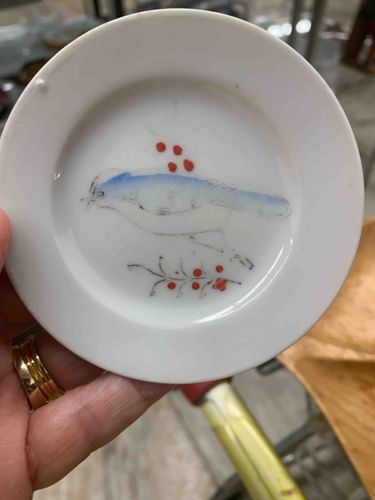
Miniature Porcelain Saucer with Hand-Painted Bird and Berries

Dinnerware / Decorative Arts

AI Estimated Value

·Not an official valuation·Verify before acting

$3-5

As of May 27, 2026

AI Item Analysis

·AI can make mistakes·Verify before acting
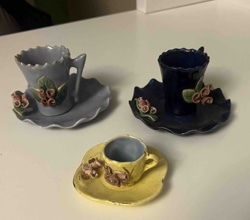
This is a small, round porcelain saucer or miniature dish, likely part of a children's tea set or a decorative cabinet piece. The item is predominantly off-white or cream-colored, suggesting fired porcelain or ceramic. Its construction is simple, with a slightly raised rim and a flat interior surface suitable for holding a small cup or serving a minute portion. The primary decoration is a hand-painted motif featuring a blue bird with a prominent crest, possibly depicting a Jay species, perched on a branch. The bird is rendered in shades of light blue with subtle black outlines or detailing around the eye and beak, and hints of darker blue or gray for contouring on its body. Below the bird, a stylized branch with red berries and muted gray-green leaves is depicted, mirroring the red berries scattered above the bird's head. The painting style appears to be somewhat impressionistic or folk art, characterized by loose brushstrokes and a degree of artistic freedom rather than hyper-realism. Visible condition issues include several chips or irregularities on the rim, particularly a noticeable chip at the top left edge as viewed in the main image, indicating wear, impact, or manufacturing imperfections. There are also what appear to be smudges or dirt marks on the surface, especially around the bird's head and body, which could be surface grime or inherent to the firing process. The 'Made in Japan' context suggests it was manufactured post-1891 (when the McKinley Tariff Act required country of origin marking) and likely from the early to mid-20th century, a period when Japanese ceramics were widely exported. The craftsmanship, while charming, indicates mass production for export markets rather than high-end artisan work, as evidenced by the slightly irregular painting and visible imperfections.
AI Appraisal Report

·AI can make mistakes·Verify before acting
Upon examining this miniature porcelain saucer, my assessment is that it is a charming, though common, example of mid-20th century Japanese export ware. The hand-painted motif, featuring a crested blue bird, likely a Jay, and red berries, is executed in a folk-art style typical of mass-produced decorative items from this period. The 'Made in Japan' mark corroborates this origin, placing its production sometime after 1891, with the style suggesting a date closer to the 1940s-1960s. The condition significantly impacts its value. I have noted several chips along the rim and surface abrasions, which are common for such pieces but detract from their desirability among collectors. These items were produced in vast quantities, and as such, they are not considered rare. The current market for mid-century Japanese export porcelain is relatively soft, with high supply and modest demand. Collectors typically seek out pieces in mint condition or those with exceptionally fine or unusual decoration.Comparable saucers, often found separated from their original children's tea sets, frequently appear in online marketplaces and at flea markets. Their value is primarily decorative rather than being tied to significant collector demand. While the piece appears authentic to its type and period based on the image, a definitive verification of the porcelain body and glazes would require physical inspection. There are no immediate signs of forgery, as the item's low intrinsic value makes it an unlikely candidate for reproduction. A full authentication would simply involve hands-on confirmation of the ceramic type and markings.

Get your items appraised

Instant estimates of your treasures with AI-powered appraisals

Browse More Appraisals