These notes were written by the person who submitted this item. Appraiser.AI has not verified them, and the AI's identification and estimate may rely on them.
AI Estimated Value
Not an official valuation
$40-$70
AI estimate as of July 27, 2025 · verify with a professional before acting
AI-Generated · Verify before acting
Everything on this page is generated by AI for informational purposes only. AI can make mistakes — the AI may misidentify items or misattribute them (artist, maker, brand, designer, origin, era). This is not an official valuation and should not be used for insurance, sale, tax, estate, legal, or lending purposes — or any decision requiring a certified appraisal. It is not an authoritative claim about any person, brand, or rights holder — do not share or rely on it as a factual statement about a third party. Always consult qualified professionals before making financial decisions.
This analysis also relies on unverified notes provided by the user, which may be incomplete or inaccurate and could affect the result.
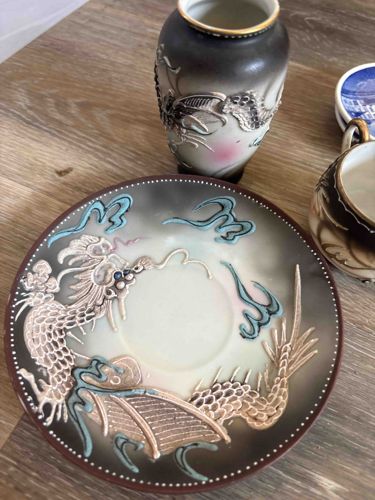
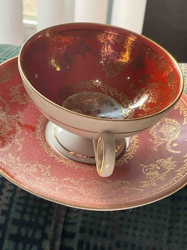
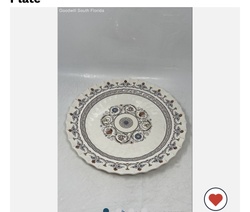
This item is a Japanese Kutani porcelain teacup saucer, likely part of a broader tea set or demitasse set, made in Japan. It features a distinctive 'dragonware' or moriage (slip-trailed decoration) technique, creating a raised, tactile surface. The saucer's central well is off-white or cream, transitioning to a dark, almost black or very dark grey rim. A prominent, ornate dragon motif is depicted in raised enamels, primarily in metallic silver, gold, and bronze tones, with intricate scale details and a fierce expression. The dragon's body wraps around the saucer, with its head positioned near the edge of the central well and its tail extending towards the opposite side. Notably, the dragon's eyes appear to be small blue beads, typical of Kutani dragonware. Swirling cloud-like patterns in light blue and grey tones complement the dragon design, adding to the mythical aesthetic. The outer rim of the saucer is a rich reddish-brown, encircled by a series of small, raised white dots, indicating careful detail work. The overall condition appears good, with minor signs of wear expected from age and use, such as slight loss to the raised enamels or possible crazing, though these cannot be fully confirmed without closer inspection. The craftsmanship is evident in the intricate moriage work and the precise painting, suggesting a mid-20th century production, consistent with the popularity of these specific Japanese export wares during that period. The associated vase in the background appears to be part of a matching set, exhibiting similar design characteristics and color palette.
AI Appraisal Report
Upon examining the provided image and description, this Japanese Kutani Dragonware Teacup Saucer exhibits the hallmark characteristics of Kutani export wares from the mid-20th century, specifically the popular 'dragonware' style utilizing moriage (slip-trailed decoration). The raised enamel dragon, with its metallic tones and characteristic bead eyes, alongside the swirling cloud patterns and raised white dots on the rim, are consistent with documented examples from this period. The overall condition, as described, appears good, with expected minor wear. Authenticity for this type of ware is generally confirmed by the distinctive moriage technique and Kutani backstamps, though the latter is not visible here. Without direct physical examination, I cannot definitively confirm minor condition issues such as crazing or specific enamel loss.
Market analysis for Kutani dragonware of this period typically shows strong collector interest, particularly for complete sets or well-preserved individual pieces. While this is a saucer only, the quality of the moriage appears high. Comparable single saucers or teacups, depending on condition and intricacy, can fetch various prices. Demand remains steady among collectors of Japanese porcelain and specific Kutani styles. Rarity for individual saucers is low, as many were produced; however, very high-quality examples or those belonging to scarce patterns can command higher prices. Factors impacting value include overall artistic quality, condition, and the distinctiveness of the dragon motif.
Limitations in authenticity verification from images alone are significant. A hands-on examination would be necessary to inspect for repairs, true enamel loss, crazing, and to locate and verify any maker's marks or backstamps, which are crucial for full authentication and precise dating. Scientific testing is generally not required for this type of ware, but provenance documentation, if available (e.g., original purchase receipts), would add considerable value.