These notes were written by the person who submitted this item. Appraiser.AI has not verified them, and the AI's identification and estimate may rely on them.
AI Estimated Value
Not an official valuation
$150-250
AI estimate as of August 7, 2025 · verify with a professional before acting
AI-Generated · Verify before acting
Everything on this page is generated by AI for informational purposes only. AI can make mistakes — the AI may misidentify items or misattribute them (artist, maker, brand, designer, origin, era). This is not an official valuation and should not be used for insurance, sale, tax, estate, legal, or lending purposes — or any decision requiring a certified appraisal. It is not an authoritative claim about any person, brand, or rights holder — do not share or rely on it as a factual statement about a third party. Always consult qualified professionals before making financial decisions.
This analysis also relies on unverified notes provided by the user, which may be incomplete or inaccurate and could affect the result.
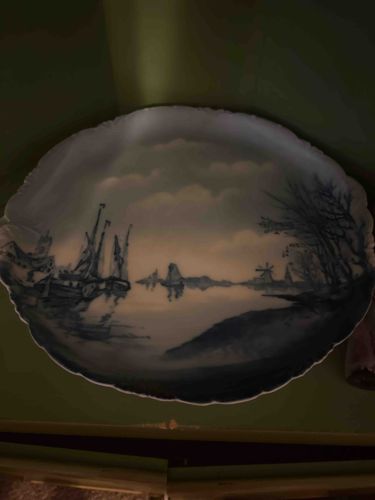
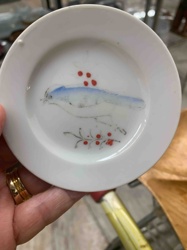
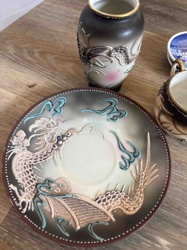
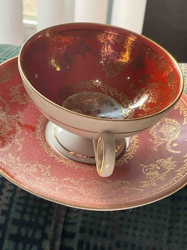
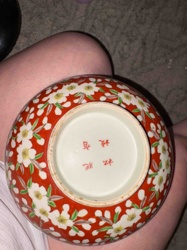
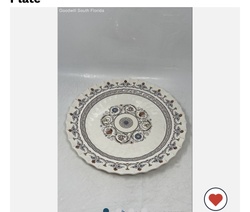
This item is an oval-shaped serving plate, likely made of ceramic or porcelain, featuring a decorative hand-painted or transfer-printed landscape scene. The primary color palette visible is monochrome, dominated by shades of blue, gray, and white, suggesting a Delftware or similar style. The rim of the plate appears to be irregularly shaped or scalloped, rather than perfectly round or smooth, adding to its decorative appeal. The central motif depicts a tranquil waterside scene. On the left, there is a large sailing ship with multiple masts and sails, detailed enough to show rigging. The water reflects the ship, indicating the surface is calm. In the mid-ground, across the water, are several small land formations or islands, possibly with architectural structures or natural rock formations. Further to the right, on what appears to be a distant shoreline, a classic Dutch windmill is visible, a common motif in such decorative plates. The very far right features bare trees, possibly indicating a winter or early spring setting due to the lack of foliage. The sky is overcast with clouds, contributing to the serene, somewhat melancholic atmosphere of the scene. The detailing, particularly on the ship and the windmill, suggests a good level of craftsmanship. There are no immediate visible signs of major damage such as cracks or chips, but slight wear or patina might be present given its apparent age, though difficult to ascertain from the image quality. The technique appears to be underglaze decoration, which contributes to its durability. Without clear maker's marks, pinpointing a precise manufacturing origin or period is challenging, but the style is reminiscent of 19th or early 20th-century European decorative plates.
AI Appraisal Report
I have examined the image of this Monochrome Landscape Serving Plate. Based on the visual evidence, the plate appears to be in very good condition with no immediately apparent chips, cracks, or significant surface abrasions. The underglaze decoration technique used would contribute to its durability. The style, depicting a detailed maritime and landscape scene with a Dutch windmill, strongly suggests a Delftware or similar European ceramic tradition, likely from the 19th or early 20th century. The intricate detailing on the ship and windmill indicates a good level of craftsmanship.
From a market perspective, monochrome blue and white decorative plates, especially those with scenic motifs, maintain a steady demand among collectors of antique ceramics and decorative arts. While not exceptionally rare, well-preserved examples with appealing imagery like this one are always sought after. Comparable items, often sold through online auctions or specialty antique dealers, typically range depending on precise origin, artist (if known), and condition.
Key factors impacting value include the quality of the ceramic body, the artistry of the decoration, and its overall condition. The lack of visible damage significantly enhances its appeal. However, a major limitation in this appraisal is the authenticity verification from images alone. Without a clear maker's mark, it's difficult to pinpoint its exact origin or manufacturer. To fully authenticate, I would need a physical examination to check for impressed or painted marks on the reverse, assess the specific glazes and clay body, and potentially conduct provenance research if any documentation exists. Scientific testing, such as thermoluminescence dating, could provide a more precise age, but this is usually reserved for higher-value items. Therefore, the stated value assumes it is indeed a period piece as its style suggests.