AI estimate as of November 8, 2025 · verify with a professional before acting
AI-Generated · Verify before acting
Everything on this page is generated by AI for informational purposes only. AI can make mistakes — the AI may misidentify items or misattribute them (artist, maker, brand, designer, origin, era). This is not an official valuation and should not be used for insurance, sale, tax, estate, legal, or lending purposes — or any decision requiring a certified appraisal. It is not an authoritative claim about any person, brand, or rights holder — do not share or rely on it as a factual statement about a third party. Always consult qualified professionals before making financial decisions.
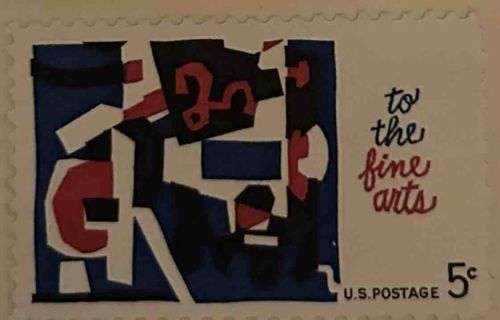
This item is a United States postage stamp, specifically the 'To The Fine Arts' commemorative issue from 1962. The stamp features a rectangular shape with characteristic perforated edges, indicating it was intended to be torn from a sheet. Its primary colors include white, dark blue, red, and black, against a generally light background. The stamp's design is an abstract, cubist-influenced artwork that occupies the left two-thirds of the stamp face. This artwork consists of various geometric shapes and organic lines in blue, red, white, and black, suggesting a dynamic, fragmented composition. On the right side of the stamp, the phrase 'to the fine arts' is printed in a stylized, flowing sans-serif script, primarily in red, with 'to the' in black. Below this text, in the bottom right corner, 'U.S. POSTAGE' is printed in a small, black sans-serif font, followed by '5′′' for the denomination, also in black. The overall style reflects mid-20th-century modern art sensibilities, aligning with the early 1960s. The visible condition appears to be relatively good for a vintage stamp, with no obvious major tears, creases, or significant discoloration. The perforations are intact, suggesting it has not been roughly handled or removed from an envelope. The colors remain vibrant. This stamp is an example of the postal service's effort to integrate modern art into its issues and commemorate cultural themes.
AI Appraisal Report
Based on my visual examination of the provided image, this U.S. Postage 'To The Fine Arts' 5-cent Stamp (1962) appears to be in very good condition. The colors are vibrant, and the perforations are intact, suggesting it has been well-preserved and possibly never hinged. Authenticity, based solely on the image, appears to be consistent with known examples of this issue; there are no immediate red flags for counterfeiting, though definitive verification would require in-person inspection.
Regarding market conditions, this stamp, Scott #1204, is a common commemorative issue. Produced in large quantities, it is readily available to collectors. Comparable sales for uncancelled, well-centered examples typically fall within the sub-dollar range. Demand is generally low to moderate for this specific issue, as it is not considered rare. Factors significantly impacting its value include its commonality and the relatively low face value at the time of issue, which does not translate into significant aftermarket value. Its primary appeal is as a collectible from a specific era of postal art.
My valuation of $0.20 - $0.50 reflects the current market for a single, uncancelled stamp in good-to-very-fine condition. Limitations in authentication from an image alone include the inability to inspect for subtle paper characteristics, gum type, watermarks, or phosphorescent tagging, all of which are crucial for a definitive authentication and grading. Full authentication would necessitate a physical examination under magnification, and potentially a review of its provenance if higher values were being ascribed.