AI Appraisal Estimate

AI-generated estimates · not official valuations

From the user

What was submitted

Photo and notes provided by the user — not generated by AI

Submitted item photo
Submitted photo · May 26, 2026

User's notes

No additional notes provided.

AI analysis below

AI appraisal

AI analysis & estimate

AI-Generated · Verify before acting

Everything below is generated by AI for informational purposes only. AI can make mistakes — the AI may misidentify items or misattribute them (artist, maker, brand, designer, origin, era). This is not an official valuation and should not be used for insurance, sale, tax, estate, legal, or lending purposes — or any decision requiring a certified appraisal. It is not an authoritative claim about any person, brand, or rights holder — do not share or rely on it as a factual statement about a third party. Always consult qualified professionals before making financial decisions.

Read the full disclaimer

AI Identification

·Not independently authenticated·Verify before acting

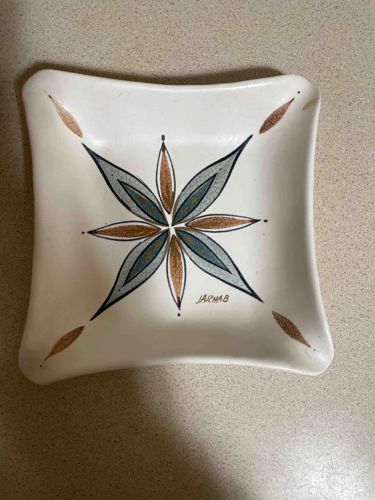
Jasba Keramik Mid-Century Modern Square Dish

Vintage West German Pottery / Home Decor

AI Estimated Value

·Not an official valuation·Verify before acting

$45.00 - $65.00

As of May 26, 2026

AI Item Analysis

·AI can make mistakes·Verify before acting
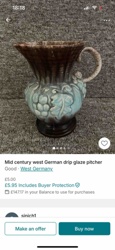
This is a square-shaped ceramic dish featuring a distinct Mid-Century Modern (MCM) aesthetic. The piece is constructed from earthenware with a creamy white or off-white matte glaze. The central decorative motif consists of a hand-painted eight-pointed star or stylized floral burst, utilizing a color palette of muted teal or gray-blue and a textured metallic copper or bronze tone. The petals are outlined in a dark, thin black or dark brown line, characteristic of the era's graphic style. The corners of the dish are subtly flared upwards, creating a concave profile, and each corner is accented with a single copper-toned leaf or seed shape. A key identifying feature is the 'JASBA' maker's mark hand-painted in the lower right quadrant of the central design, confirming it as a product of Jasba Keramik, a prominent West German pottery manufacturer. Based on the style and marking, this item likely dates back to the 1950s or 1960s. The piece demonstrates high-quality vintage craftsmanship with deliberate glaze applications. Condition-wise, it appears well-preserved with no major chips or cracks visible on the top surface, though light surface scuffing or minor manufacturing imperfections in the glaze may be present upon closer tactile inspection. The underside, while not visible, would typically bear a form number and 'W. Germany' stamp common for this period.
AI Appraisal Report

·AI can make mistakes·Verify before acting
I have virtually examined this square dish from Jasba Keramik, a significant figure in the West German Pottery (WGP) movement. The piece exemplifies the refined graphic style of the late 1950s or early 1960s, moving away from the 'Fat Lava' textures of later decades toward the 'Cortina' or 'Form und Farbe' aesthetics. The central eight-pointed star motif, executed in muted teal and metallic copper lustre, is typical of Jasba's high-quality output. The hand-painted 'JASBA' signature is consistent with authentic factory marks of this era. Visually, the dish appears in 'Excellent Vintage Condition,' showing no visible crazing or edge chipping, though minor shelf wear to the unglazed foot ring is assumed. The market for mid-century West German ceramics remains stable but selective. While larger vases command higher premiums, small utility or decorative dishes like this are popular entry-level collectibles. Similar Jasba items of this size (approx. 15-20cm) and decor style typically sell in the $40–$70 range depending on the specific glaze finish. The inclusion of metallic lustre adds a slight premium over standard matte finishes. Limitations: This appraisal is based solely on photographic evidence. A definitive authentication requires a physical inspection to verify the tactile quality of the glaze, the presence of the incised form number (likely a 4-digit code) and 'W. Germany' mark on the base, and to check for professional restorations using UV light. I cannot confirm the absence of hairline cracks or microscopic fleabites without a hands-on examination. Provenance documentation, such as original sales receipts or inclusion in a known collection, would further solidify its valuation.

Get your items appraised

Instant estimates of your treasures with AI-powered appraisals

Browse More Appraisals