AI estimate as of July 30, 2025 · verify with a professional before acting
AI-Generated · Verify before acting
Everything on this page is generated by AI for informational purposes only. AI can make mistakes — the AI may misidentify items or misattribute them (artist, maker, brand, designer, origin, era). This is not an official valuation and should not be used for insurance, sale, tax, estate, legal, or lending purposes — or any decision requiring a certified appraisal. It is not an authoritative claim about any person, brand, or rights holder — do not share or rely on it as a factual statement about a third party. Always consult qualified professionals before making financial decisions.
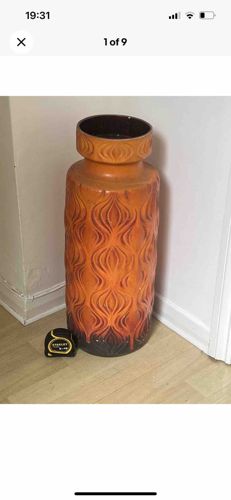
This is a large, cylindrical floor vase, likely made of ceramic or pottery, with a distinctive mid-century modern aesthetic. Its dominant color is a rich, fiery orange, which transitions into a darker, almost burnt orange or brown towards the base, appearing as if the glaze is intentionally 'dripping' downwards, adding a dynamic, organic feel. The surface of the main body is heavily textured with an embossed, repetitive pattern reminiscent of stylized flames or elongated teardrops, arranged in vertical rows, giving it a tactile and visually engaging quality. The top section of the vase narrows slightly before flaring out to a circular lip, which is unglazed or finished in a dark, matte brown/black, matching the base color. This top ring also features a raised, repeating pattern, echoing the design on the main body but in a more condensed form. The interior of the vase appears to be dark brown or black, providing a strong contrast to the bright exterior. There are no obvious signs of significant damage like chips or cracks visible in the image, suggesting it has been well-preserved. There is a general patina consistent with age, but no severe wear is apparent. The overall construction appears robust and substantial, indicative of a quality piece. Based on its design, color palette, and textured finish, this vase strongly aligns with the Fat Lava pottery style, popular in West Germany from the 1960s to the 1980s. The size, inferred by the Stanley tape measure next to it, indicates it is a substantial floor piece, likely exceeding 2 to 3 feet in height. No specific maker's marks or signatures are visible in the provided image.
AI Appraisal Report
Upon examining the provided image, I have assessed this Mid-Century Modern Fat Lava style floor vase. The condition appears to be excellent, with no visible chips, cracks, or significant wear. The rich, fiery orange glaze with its characteristic 'dripping' effect and the heavily textured surface are highly indicative of the Fat Lava pottery style, particularly from West Germany during the 1960s-1980s. The large size, as suggested by the proximity of the Stanley tape measure, makes it a desirable floor piece.
Market conditions for vintage Fat Lava pottery remain strong, especially for larger, well-preserved examples with striking aesthetics. Comparables for such pieces often appear at specialist auctions and curated vintage decor sites, indicating a consistent demand. While Fat Lava was produced in quantity, vases of this commanding size and vibrant, textured design are less common, contributing to its desirability.
Factors significantly impacting value include its substantial size, excellent condition, and strong adherence to the iconic Fat Lava aesthetic. The vivid orange color is particularly sought after. The absence of specific maker's marks is a limitation from images alone. Without physical inspection, I cannot confirm the specific manufacturer (e.g., Scheurich, Bay Keramik, etc.), which could influence the precise value. For full authentication and to ascertain the maker, an in-person examination, including inspecting the base for marks, checking for internal glazes, and possibly provenance documentation, would be beneficial. Despite this, its visual characteristics strongly support its attributed style and period.