AI estimate as of July 17, 2025 · verify with a professional before acting
AI-Generated · Verify before acting
Everything on this page is generated by AI for informational purposes only. AI can make mistakes — the AI may misidentify items or misattribute them (artist, maker, brand, designer, origin, era). This is not an official valuation and should not be used for insurance, sale, tax, estate, legal, or lending purposes — or any decision requiring a certified appraisal. It is not an authoritative claim about any person, brand, or rights holder — do not share or rely on it as a factual statement about a third party. Always consult qualified professionals before making financial decisions.
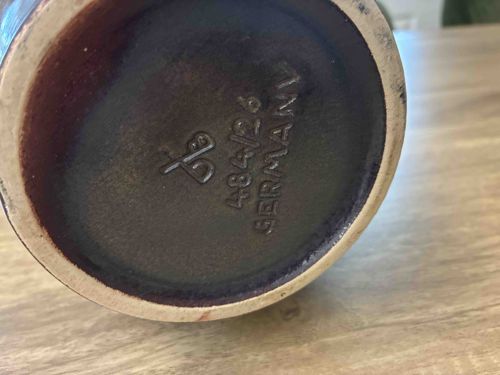
The item is the base of a ceramic vessel, likely a vase or jug, characterized by its dark, possibly dark brown or black, glazed interior surface and a lighter, unglazed or differently finished rim. The base appears circular, and the visible portion suggests a sturdy construction. A notable feature is the impressed manufacturer's mark on the center of the base. This mark consists of an emblem or maker's stamp, which vaguely resembles stylized initials or a symbol, followed by the alphanumeric code '484/26' and the country of origin 'GERMANY'. The 'GERMANY' text is oriented vertically along the curvature of the base. The impression of these markings suggests a manufacturing process where the base was shaped, and the details were pressed into the clay before firing. There are no obvious signs of significant damage like chips or cracks visible in this view, though some slight surface wear or minor scuffs consistent with typical use or handling might be present on the unglazed rim. The overall impression is one of vintage or mid-20th-century ceramic ware, likely West German pottery given the 'GERMANY' marking, a common origin for such items. The craftsmanship appears robust, indicating standard industrial ceramic production.
AI Appraisal Report
Upon visual examination of the provided image, I assess this ceramic vessel base to be in good vintage condition. The dark glazed interior appears intact, and there are no discernible chips, cracks, or significant damage. Some minor surface wear or scuffs on the unglazed rim are consistent with age and typical handling, which is to be expected for an item of this type and era. The impressed mark '484/26' and 'GERMANY' are clear and well-defined, strongly indicating authenticity as a West German ceramic piece. The 'GERMANY' marking, oriented vertically, is characteristic of mid-20th-century production.
Market conditions for West German pottery have seen steady interest over the past decade, especially for well-preserved examples by known manufacturers. While this specific maker's mark (the emblem before '484/26') is not immediately identifiable without further research, the general category of West German ceramics maintains a collector base. Demand is moderate, with desirability often influenced by the unique design, glazes, and overall form of the complete vessel, which is not visible here. Rarity depends entirely on the specific manufacturer and model; many West German pieces were mass-produced, while others were made in more limited quantities. The value of this piece is primarily as a part of a potentially desirable larger vessel, or as a standalone fragment of collectible pottery for enthusiasts focusing on maker's marks or specific production periods.
Factors significantly impacting value for a complete piece would be its full design, condition of the upper body, and the specific manufacturer's reputation. For this base alone, the value is limited. Without knowing the original complete form, the value is reduced.
Limitations in authenticity verification from images alone include the inability to physically inspect the ceramic body for subtle flaws, the exact texture and quality of the clay, or the true depth and clarity of the impressed mark. A physical examination would allow for a tactile assessment of the unglazed rim for microscopic wear patterns and residue, and help identify the exact clay body. Provenance documentation, if available, could confirm its origin and history. Scientific testing, such as thermoluminescence dating, would be excessive for an item of this value but could definitively determine age if authenticity were ever truly challenged.