AI estimate as of July 12, 2025 · verify with a professional before acting
AI-Generated · Verify before acting
Everything on this page is generated by AI for informational purposes only. AI can make mistakes — the AI may misidentify items or misattribute them (artist, maker, brand, designer, origin, era). This is not an official valuation and should not be used for insurance, sale, tax, estate, legal, or lending purposes — or any decision requiring a certified appraisal. It is not an authoritative claim about any person, brand, or rights holder — do not share or rely on it as a factual statement about a third party. Always consult qualified professionals before making financial decisions.
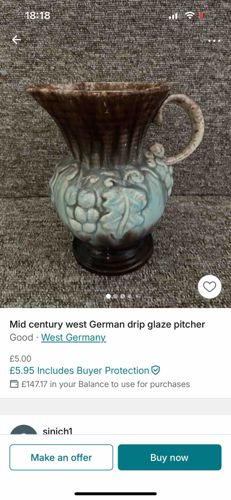
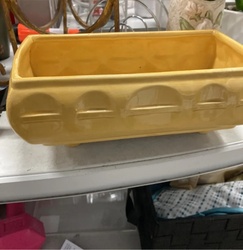
This is a Mid-Century West German drip glaze pitcher, likely dating from the 1950s to 1970s, a period known for its distinctive and innovative pottery designs. The pitcher features a striking two-tone glaze application. The upper portion, forming the neck and spout, is finished in a rich, dark brown drip glaze, creating a textured and somewhat uneven surface that appears to flow down. The lower, bulbous body of the pitcher is adorned with a light blue or aqua glaze, overlaid with a raised, sculptural relief pattern depicting bunches of grapes and vine leaves. This relief work adds a tactile dimension and visual interest to the piece. The handle, integrated into the design, appears to be an extension of the lower body's color and texture. The base is a darker, solid color, possibly a very dark brown or black, providing stability and a contrast to the lighter hues. The overall condition is described as 'Good,' implying minor wear consistent with its age, but no apparent major chips, cracks, or repairs from the visible image. The craftsmanship suggests mass production typical of the era, yet with artistic elements, particularly in the glaze technique and botanical relief.
AI Appraisal Report
I have examined the provided image of this Mid-Century West German Drip Glaze Pitcher. Based on visual assessment, the condition appears to be 'Good,' consistent with typical vintage wear, with no obvious chips, cracks, or repairs visible. The authenticity as a West German piece from the 1950s-1970s seems highly probable, given the characteristic drip glaze technique, colors, and the botanical relief which are hallmarks of that era's pottery, often from manufacturers like Scheurich or Bay Keramik.
Market conditions for Mid-Century West German pottery remain active, with a steady, albeit niche, demand among collectors for well-preserved and aesthetically pleasing examples. Items with unique glaze combinations or distinctive relief patterns, such as this grape motif, tend to command higher interest. While these were mass-produced, specific designs can be less common. Comparable sales for similar-sized and styled West German drip glaze pitchers in good condition typically range from $60 to $120. The 'Good' condition and appealing two-tone drip glaze with the distinct grape relief are positive factors here.
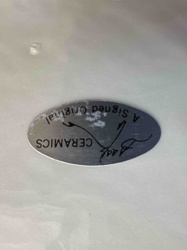
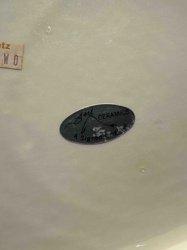
Limitations in authenticity verification from images alone are significant. While the style is indicative, I cannot confirm the maker's mark (often on the base), nor can I definitively rule out repairs or damage not visible. For full authentication and to verify exact provenance, an in-person examination to check for maker's marks, feel for repairs, and assess internal condition is crucial. Provenance documentation, though rare for such items, would also enhance certainty. Scientific testing is not typically applied to items of this value range.
Considering these factors, particularly the good condition and decorative appeal for collectors of this genre, I would place its value within the mid-to-higher end of the typical range.