AI estimate as of July 12, 2025 · verify with a professional before acting
AI-Generated · Verify before acting
Everything on this page is generated by AI for informational purposes only. AI can make mistakes — the AI may misidentify items or misattribute them (artist, maker, brand, designer, origin, era). This is not an official valuation and should not be used for insurance, sale, tax, estate, legal, or lending purposes — or any decision requiring a certified appraisal. It is not an authoritative claim about any person, brand, or rights holder — do not share or rely on it as a factual statement about a third party. Always consult qualified professionals before making financial decisions.
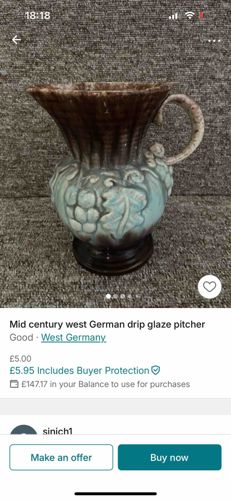
This is a Mid-Century West German drip glaze pitcher, likely constructed from ceramic or pottery given its appearance. The pitcher features a distinctive two-tone glaze. The upper portion, including the flared rim and the top part of the body, is finished in a rich, dark brown drip glaze, which shows individual streaks and variations in color intensity, typical of this glazing technique. The lower, bulbous section of the body is adorned with a light blue or teal glaze, showcasing raised, sculptural details of grapes and vine leaves, indicating a figural or nature-inspired design. The base of the pitcher appears to be a solid, dark brown, possibly unglazed or ebonized, providing a stable foundation. The handle, located on one side, is also glazed in a similar light blue/brown mottled pattern, and appears sturdy and integrated into the design. The overall condition appears to be 'Good', as stated in the accompanying text, suggesting minimal visible damage, chips, or cracks, though some light wear consistent with age and use (e.g., minor scuffs or subtle patina) might be present. The manufacturing origin is specified as West Germany, dating it between 1949 and 1990, consistent with the 'Mid-Century' classification which typically refers to the 1950s and 1960s.
The craftsmanship suggests mass production, but with individual glaze application, making each piece somewhat unique. The sculptural grape and leaf detailing showcases a decorative quality characteristic of West German pottery from the era, often focusing on organic forms and vibrant glazes. There are no immediate visible maker's marks or signatures from the provided image, though these would typically be found on the base. The lack of significant visible wear indicates it has been reasonably well-preserved for its age. The item's proportions seem balanced, with a wide opening for practicality and a decorative body for aesthetic appeal.
AI Appraisal Report
Upon visual examination of the provided image, this Mid-Century West German drip glaze pitcher presents in 'Good' condition, consistent with the description. I observe no obvious chips, cracks, or significant damage, though minor scuffs or subtle patina, typical with age and use, are likely present. Authenticity, based on the distinctive two-tone drip glaze, sculptural grape and vine leaf detailing, and specified origin, aligns well with known West German pottery from the mid-20th century. However, without physical examination, I cannot definitively confirm its authenticity or rule out repairs not visible in the image.
The market for Mid-Century West German pottery remains steady, with pieces exhibiting unique glazes and sculptural elements like this one attracting consistent interest. Comparables, particularly those from well-known manufacturers such as Scheurich, Bay Keramik, or Roth Keramik (though no specific maker's mark is visible here), typically fetch values in the lower to mid-hundreds for well-preserved examples. Demand is moderate, driven by collectors of vintage home decor and specific pottery enthusiasts. Rarity is limited; while each piece is unique due to drip glaze application, the overall style and production type were widespread.
Factors significantly impacting value include the excellent preservation of the glaze and sculptural details. Conversely, the lack of a visible maker's mark or specific provenance documentation limits its top-tier collector appeal. For full authentication, an in-person examination would be crucial to inspect the base for maker's marks, assess the true condition, and verify the ceramic body and glazing techniques. Provenance documentation could further enhance its value, and scientific testing, while typically not pursued for items in this price range, could confirm material composition if doubt arose.