These notes were written by the person who submitted this item. Appraiser.AI has not verified them, and the AI's identification and estimate may rely on them.
AI Estimated Value
Not an official valuation
$600-900
AI estimate as of October 3, 2025 · verify with a professional before acting
AI-Generated · Verify before acting
Everything on this page is generated by AI for informational purposes only. AI can make mistakes — the AI may misidentify items or misattribute them (artist, maker, brand, designer, origin, era). This is not an official valuation and should not be used for insurance, sale, tax, estate, legal, or lending purposes — or any decision requiring a certified appraisal. It is not an authoritative claim about any person, brand, or rights holder — do not share or rely on it as a factual statement about a third party. Always consult qualified professionals before making financial decisions.
This analysis also relies on unverified notes provided by the user, which may be incomplete or inaccurate and could affect the result.
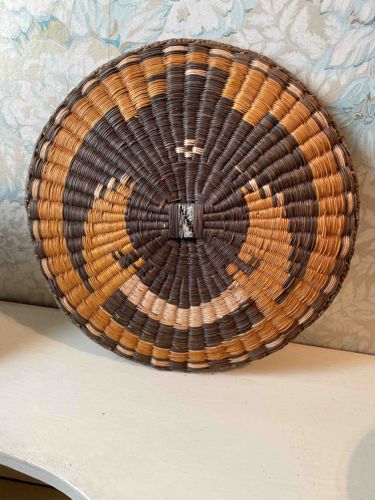
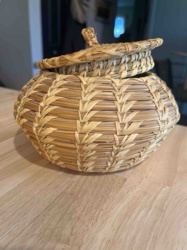
This item is a circular, coiled basketry plaque, likely made from natural plant fibers, possibly yucca or sumac, and dyed elements. The plaque exhibits a distinctive design composed of dark brown, light brown/tan, and a very light, almost off-white, natural fiber color. The pattern radiates from a square central element, which appears to be woven with a lighter, perhaps natural, and darker fiber. Surrounding this center are concentric bands of geometric motifs. The primary design consists of broad, sweeping arcs and triangular or stepped patterns, alternating between the dark brown and light brown/tan fibers, creating a visually dynamic effect. There are also smaller, delicate patterns woven into the darker sections, featuring small squares or 'X' shapes in the lighter fibers, suggesting a high level of craftsmanship and attention to detail. The coiling technique is visible throughout, indicating a sturdy and traditional construction method, where bundles of fiber are sewn together in a spiraling fashion. The edges appear tightly finished, maintaining the circular form. Given the 'Turn of 20th century plaque' context, this piece is likely a Native American woven plateau basket or plaque, characteristic of Southwestern or Californian tribes. Visible condition issues include some general wear consistent with age, such as slight discoloration of the lighter fibers and minor fraying in isolated areas, particularly around the edges and potentially within the central square. The colors, while still vibrant, show a softened patina suggestive of natural aging. There are no obvious signs of significant damage, repairs, or explicit maker's marks observable from the provided image, though such details might be present on the reverse or require closer inspection. The quality of weaving appears fine and consistent, indicative of a skilled artisan. The plaque's purpose would typically be decorative, possibly for display on a wall or as a ceremonial object.
AI Appraisal Report
Upon examining the provided image of this Native American Coiled Basketry Plaque, I can offer the following appraisal. This circular plaque displays a finely executed coiling technique, characteristic of traditional Southwestern or Californian tribal weaving from the turn of the 20th century, which aligns with the owner's provided context. The design, with its radiating geometric motifs in dark brown, light brown/tan, and nearly off-white fibers around a square central element, suggests a skilled artisan. The smaller, delicate 'X' or square patterns within the darker sections further speak to the craftsmanship.
From the visual evidence, the condition appears good for its age. I note some expected wear, such as slight discoloration of the lighter fibers and minor fraying, particularly at the edges and potentially the central square, which is consistent with a piece over a century old. The colors retain vibrancy but show a softened patina, adding to its authenticity as an antique. There are no obvious signs of significant damage, repairs, or explicit maker's marks from this image alone.
In terms of market conditions, similar turn-of-the-century coiled basketry plaques of good condition and attractive design, particularly from well-known Southwestern or Californian tribes like the Pima, Apache, or Yokuts, are consistently sought after by collectors of Native American art. Demand remains steady for authentic, well-preserved examples. The lack of major damage and the pleasing aesthetic contribute positively to its marketability.
Factors significantly impacting value include the fineness of the weave, the intricacy and balance of the design, the quality of the fibers, and the overall state of preservation. The appealing design and apparent quality of this piece support a solid appraisal.
It is crucial to state that this appraisal is based solely on visual inspection of the provided image. Definitive authenticity, tribal attribution, specific age, and the presence of any repairs hidden from view cannot be fully confirmed without an in-person physical examination. A hands-on inspection would allow for tactile assessment of fiber types, closer examination of weave consistency, and a more thorough search for signatures or provenance documentation on the reverse. Scientific testing might be employed to confirm fiber age or dye origins in rare cases, but is usually not necessary for standard authentication of such pieces.