Framed Navajo Sandpainting
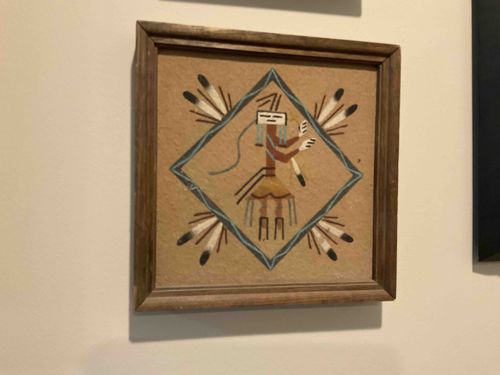
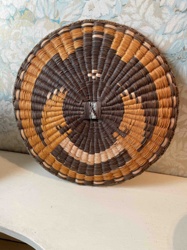
This is a native Navajo sandpainting depicting a Yeibichai or Yei figure, a spiritual entity in Navajo culture. The artwork is created using various colors of naturally dyed crushed sand and minerals applied onto a fiberboard or wood backing. The central figure is enclosed within a diamond-shaped border of blue and white 'rainbow' motifs, surrounded by four stylized feather bundles pointing towards the corners. The palette consists of earth tones including ochre, terra cotta, charcoal black, white, and a muted turquoise blue. The composition is highly symmetrical and traditional in style, likely dating from the mid-to-late 20th century (circa 1960s-1980s). It is housed in a simple, rustic dark wood frame with a visible grain that shows minor scuffing and wear on the edges. The sand surface appears well-preserved with no significant loss of material or 'shedding' visible, though some minor discoloration or fading from age is present. The craftsmanship displays the characteristic precision of traditional sandpainting, with fine lines and consistent texture. While no signature is immediately visible on the front, such pieces often have artist information or tribal affiliation on the reverse side. The item is decorative but holds cultural significance as an interpretation of sacred ceremonial motifs made for the commercial market.
AI-Generated Appraisal Disclaimer
Estimated Value
$150-$300
Basic Information
Category
Native American Art / Indigenous Crafts
Appraised On
December 28, 2025
Estimated Value
$150-$300
Item Description
This is a native Navajo sandpainting depicting a Yeibichai or Yei figure, a spiritual entity in Navajo culture. The artwork is created using various colors of naturally dyed crushed sand and minerals applied onto a fiberboard or wood backing. The central figure is enclosed within a diamond-shaped border of blue and white 'rainbow' motifs, surrounded by four stylized feather bundles pointing towards the corners. The palette consists of earth tones including ochre, terra cotta, charcoal black, white, and a muted turquoise blue. The composition is highly symmetrical and traditional in style, likely dating from the mid-to-late 20th century (circa 1960s-1980s). It is housed in a simple, rustic dark wood frame with a visible grain that shows minor scuffing and wear on the edges. The sand surface appears well-preserved with no significant loss of material or 'shedding' visible, though some minor discoloration or fading from age is present. The craftsmanship displays the characteristic precision of traditional sandpainting, with fine lines and consistent texture. While no signature is immediately visible on the front, such pieces often have artist information or tribal affiliation on the reverse side. The item is decorative but holds cultural significance as an interpretation of sacred ceremonial motifs made for the commercial market.

Get Your Items Appraised
Instant estimates of your treasures with AI-powered instant appraisals