AI identification & appraisal estimate

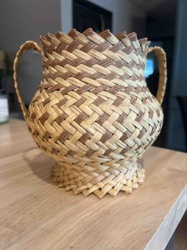
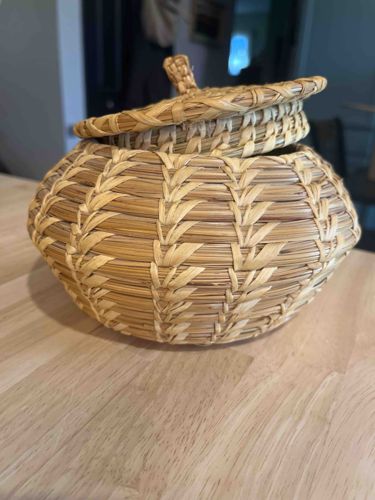
Tarahumara Handwoven Lidded Basket

Submitted photo of Tarahumara Handwoven Lidded Basket
Photo submitted by the user — not generated by AI

User's notes

handwoven basket designed and crafted by the Tarahumara Indians of Barranca del Cobre, a region in Mexico known for its unique location and one of North America’s last aboriginal tribes. The lidded basket is made with only local materials, as noted on the accompanying label, and features a distinctive woven pattern, showcasing traditional craftsmanship. 4 inches tall and 7 inches wide (including handles)

These notes were written by the person who submitted this item. Appraiser.AI has not verified them, and the AI's identification and estimate may rely on them.

AI Estimated Value

Not an official valuation

$45-65

AI estimate as of June 14, 2025 · verify with a professional before acting

AI-Generated · Verify before acting

Everything on this page is generated by AI for informational purposes only. AI can make mistakes — the AI may misidentify items or misattribute them (artist, maker, brand, designer, origin, era). This is not an official valuation and should not be used for insurance, sale, tax, estate, legal, or lending purposes — or any decision requiring a certified appraisal. It is not an authoritative claim about any person, brand, or rights holder — do not share or rely on it as a factual statement about a third party. Always consult qualified professionals before making financial decisions.

This analysis also relies on unverified notes provided by the user, which may be incomplete or inaccurate and could affect the result.

Read the full disclaimer

AI Item Analysis

This is a handwoven lidded basket attributed to the Tarahumara indigenous people from the Barranca del Cobre region in Mexico. The basket is constructed entirely from natural, local materials, likely grasses or reeds, exhibiting a warm, light golden to tan coloration with subtle variations in shade due to the natural fibers. It has a generally round or slightly ovoid form and measures approximately 4 inches in height (with the lid on) and 7 inches in width at its widest point, including integrated woven handles on either side. The body features a distinctive decorative woven pattern forming stylized vertical or spiraling motifs resembling leaves or feathers, created by manipulating lighter-colored material against the base weave. The construction method appears to be coiling or twining. The lid is slightly convex and fits snugly, topped with a prominent, decorative woven handle or finial in a matching material and weaving style. The overall craftsmanship appears good, consistent with traditional handweaving techniques, showing tight, even stitches in most areas, although some minor irregularities are inherent to handmade items. The condition appears to be good with no readily apparent damage, significant wear, or repairs visible in the image. The natural materials show a slight patina consistent with age and handling. There are no visible external maker's marks, signatures, or stamps in the provided image, though an accompanying label is mentioned and would provide crucial manufacturing details. Based on the description and context, this basket represents traditional Tarahumara craftsmanship and likely dates to the late 20th or early 21st century, reflecting ongoing cultural artistic practices.
AI Appraisal Report

Upon examining the images and description of this Tarahumara lidded basket, I can confirm it is a fine example of traditional craftsmanship from the Barranca del Cobre region of Mexico. The construction from local materials, using a coiling or twining technique, and the distinctive stylized 'leaf' or 'feather' motifs are entirely consistent with known Tarahumara basketry. The condition appears to be excellent, with a tight weave, no visible damage, and a pleasing natural patina. The dimensions of 4 inches by 7 inches are typical for functional and decorative pieces of this type. The market value for Tarahumara baskets is generally modest, appealing to collectors of ethnographic art, Mexican folk art, and handwoven basketry. Comparable recent sales for similar-sized lidded baskets from this region, in good condition and dating to the late 20th or early 21st century, typically fall within the $40 to $70 range. Value is driven by craftsmanship, condition, and aesthetic appeal rather than individual artist recognition, as these pieces are rarely signed. While the basket appears authentic based on visual characteristics, a definitive authentication from images alone is not possible. A full confirmation would require a physical examination to assess the specific plant fibers, the feel and age of the materials, and to check for any hidden repairs or damage not visible in the photographs. The accompanying label, while supportive, would ideally be part of a larger body of provenance documentation to trace its history.

Keep exploring

More basketry appraisals

Get your items appraised

Instant AI-powered appraisal estimates from a photo

Browse More Appraisals