AI estimate as of November 1, 2025 · verify with a professional before acting
AI-Generated · Verify before acting
Everything on this page is generated by AI for informational purposes only. AI can make mistakes — the AI may misidentify items or misattribute them (artist, maker, brand, designer, origin, era). This is not an official valuation and should not be used for insurance, sale, tax, estate, legal, or lending purposes — or any decision requiring a certified appraisal. It is not an authoritative claim about any person, brand, or rights holder — do not share or rely on it as a factual statement about a third party. Always consult qualified professionals before making financial decisions.
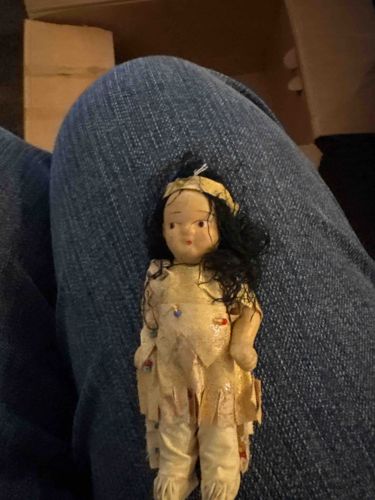
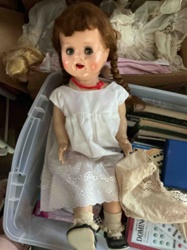
This is a small, vintage souvenir doll, likely depicting a Native American figure, though it's important to note such depictions can sometimes be generalized or stereotypical. The doll features a light-skinned, possibly bisque or composition head with painted facial features including dark eyes, thin black eyebrows, and red lips, indicating it's not made to represent a specific tribe but rather a broader, commercial interpretation. It has dark, curly synthetic hair, possibly mohair or a similar fiber, held back by a simple yellow headband. The body of the doll appears to be made of a soft material like cloth, covered by clothing that mimics traditional buckskin or hide attire. This clothing is light beige or cream-colored, fashioned into a tunic-style top with fringed edges and matching fringed trousers. The fringe details are cut into the material itself, suggesting a simplified, mass-produced approach rather than intricate handcraftsmanship. Small, colorful beads (red and blue are visible) are sparsely attached to the fringe of the tunic, adding a touch of embellishment. The doll's overall condition shows significant signs of age and wear. The fabric clothing appears somewhat discolored, possibly from dirt or age-related yellowing, and there are visible frayed edges, consistent with its age and material. There might be some cracks or paint loss on the head, though difficult to ascertain definitively from the image. The small size, general features, and construction quality suggest it was likely produced as a souvenir or child's plaything, possibly from the mid-20th century, likely between the 1940s and 1970s. No specific maker's marks or signatures are visible. Its craftsmanship is generally simple, indicative of a collectible item rather than an artisan piece.
AI Appraisal Report
Upon visual examination of this vintage souvenir doll, I observe a charming, albeit mass-produced, artifact. The light-skinned head, likely bisque or composition, with painted features and synthetic hair, suggests a commercial product. The simplified 'buckskin' attire with cut fringes and sparse beadwork further reinforces this. The doll's condition shows clear signs of age and handling: discoloration and fraying on the fabric are evident, consistent with its likely age range of mid-20th century (1940s-1970s). While such items were popular souvenirs, their general nature and lack of specific tribal representation or artisanal craftsmanship limit their collectibility as fine art or ethnographic pieces.
Market comparables for similar vintage souvenir dolls, often generically labeled 'Native American style,' typically trade in the $10-$40 range, depending primarily on condition and aesthetic appeal to individual collectors rather than historical significance. Demand is limited to niche collectors of vintage dolls or Americana. Rarity is not a significant factor here; these were mass-produced. Factors impacting value negatively include the generalized depiction, simple construction, and visible wear. Positively, its overall intactness and vintage appeal offer some value as a decorative collectible.
It is crucial to note that authenticity verification of material composition (e.g., specific type of bisque or synthetic fiber) is impossible from images alone. A physical inspection would allow for tactile assessment of materials, a more precise evaluation of wear and potential damage (e.g., hairline cracks on the head, specific paint loss), and the search for any hidden maker's marks, though such marks are rare on items of this type. Provenance documentation would be needed to confirm its exact origin or manufacturing date, which is currently speculative based on style.