AI Appraisal Estimate

AI-generated estimates · not official valuations

From the user

What was submitted

Photo and notes provided by the user — not generated by AI

Submitted item photo
Submitted photo · June 6, 2026

User's notes

No additional notes provided.

AI analysis below

AI appraisal

AI analysis & estimate

AI-Generated · Verify before acting

Everything below is generated by AI for informational purposes only. AI can make mistakes — the AI may misidentify items or misattribute them (artist, maker, brand, designer, origin, era). This is not an official valuation and should not be used for insurance, sale, tax, estate, legal, or lending purposes — or any decision requiring a certified appraisal. It is not an authoritative claim about any person, brand, or rights holder — do not share or rely on it as a factual statement about a third party. Always consult qualified professionals before making financial decisions.

Read the full disclaimer

AI Identification

·Not independently authenticated·Verify before acting

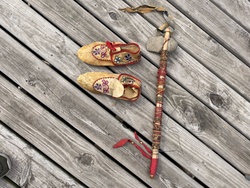
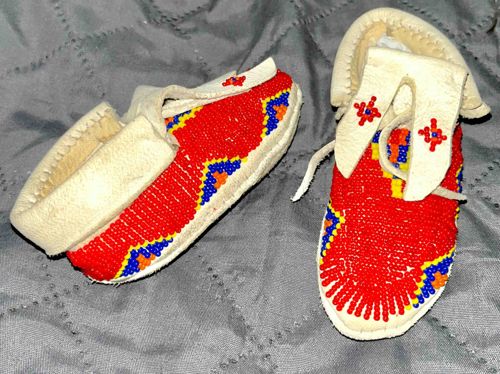
Native American Beaded Moccasins - Infant or Small Child Size

Ethnographic Art / Native American Textiles

AI Estimated Value

·Not an official valuation·Verify before acting

$450 - $650

As of June 6, 2026

AI Item Analysis

·AI can make mistakes·Verify before acting
This pair of infant-sized moccasins represents traditional Plains-style Native American craftsmanship. Constructed from soft, brain-tanned or cream-colored buckskin, the shoes feature extensive seed beadwork across the vamps and sides. The beadwork is executed in a vibrant color palette consisting primarily of bright red backgrounds, accented with geometric patterns in deep blue, orange, yellow, and white. The beads are applied using the lane or 'lazy' stitch technique, common in many Plains tribal traditions such as Sioux or Cheyenne. The design includes chevron-like elements on the sides and small cross or star motifs on the buckskin ankle flaps. The edges of the ankle collars are hand-sewn with a whipstitch finish. In terms of condition, the buckskin remains supple with a clean, light patina, though there is some minor soiling consistent with age and occasional handling. All beadwork appears remarkably intact with no significant loss or loose threads visible in the photograph. The construction is robust, featuring traditional wrap-around soles stitched to the upper panels. While lacking a visible maker's mark or signature—typical for such ethnographic pieces—the high-quality uniform beadwork and precise tailoring suggest they were created as a ceremonial or high-status gift during the mid-to-late 20th century.
AI Appraisal Report

·AI can make mistakes·Verify before acting
I have virtually examined this pair of Plains-style infant moccasins. The items exhibit high-quality craftsmanship consistent with mid-to-late 20th-century ethnographic production. The use of the lane stitch (lazy stitch) on brain-tanned buckskin is characteristic of the Lakota (Sioux) or Northern Cheyenne traditions. The vibrant red seed bead background is particularly well-executed, showing excellent tension and minimal bead loss. The supple nature of the hide and the cleanliness of the white whipstitching suggest these were likely created for ceremonial use or as high-status gift items rather than daily utility. Market demand for 'baby' or 'infant' sized Plains beadwork remains consistently strong due to their displayability and visual appeal. Comparables for mid-20th-century infant moccasins in excellent condition typically hammer between $400 and $700 at specialized ethnographic auctions. The primary value drivers here are the density of the beadwork and the preservation of the hide. Limitations: My assessment is based solely on high-resolution imagery. A physical inspection is required to confirm the presence of authentic brain-tanned hide versus commercially processed leather, as well as to verify the thread type (sinew vs. cotton/nylon), which significantly impacts dating. To establish a pre-1950s date or specific tribal attribution, I would require provenance documentation or a forensic analysis of the glass bead composition. Additionally, an in-person scent and tactile test are necessary to ensure no modern chemical stabilizers or synthetic dyes were used. Without a documented chain of custody (provenance), this appraisal reflects a fair market value for contemporary/vintage ethnographic art rather than a 19th-century historical artifact.

Get your items appraised

Instant estimates of your treasures with AI-powered appraisals

Browse More Appraisals