AI estimate as of October 14, 2025 · verify with a professional before acting
AI-Generated · Verify before acting
Everything on this page is generated by AI for informational purposes only. AI can make mistakes — the AI may misidentify items or misattribute them (artist, maker, brand, designer, origin, era). This is not an official valuation and should not be used for insurance, sale, tax, estate, legal, or lending purposes — or any decision requiring a certified appraisal. It is not an authoritative claim about any person, brand, or rights holder — do not share or rely on it as a factual statement about a third party. Always consult qualified professionals before making financial decisions.
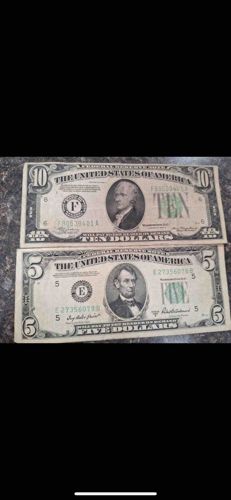
This item consists of two United States Federal Reserve Notes, specifically one Ten Dollar Bill and one Five Dollar Bill. Both notes feature the classic green ink and off-white/cream paper typical of US currency. The Ten Dollar Bill prominently displays a portrait of Alexander Hamilton on its obverse, centrally located within an oval frame. The denomination '10' is visible in all four corners, and the words 'TEN DOLLARS' are written across the bottom center. The phrase 'THE UNITED STATES OF AMERICA' is printed across the top. A Federal Reserve Bank Seal, indicated by 'F' for the Federal Reserve Bank of Atlanta, is visible on the left side. The serial number 'F80639401A' is present, along with signatures below the portrait. The Five Dollar Bill features a portrait of Abraham Lincoln, also centrally placed in an oval frame. Similar to the ten-dollar note, the denomination '5' appears in all four corners, and 'FIVE DOLLARS' is printed at the bottom center. 'THE UNITED STATES OF AMERICA' is across the top, and a Federal Reserve Bank Seal with the letter 'E' for the Federal Reserve Bank of Richmond is on the left. The serial number for the five-dollar bill is 'E27356078B'. Both notes exhibit visible signs of circulation, including creases, folds, and general softening of the paper. There is some discoloration and soiling consistent with age and use, particularly noticeable along the edges and in the white border areas. No major tears or repairs are immediately evident, but the overall condition suggests they are well-circulated rather than uncirculated or crisp. These bills represent standard US currency from an earlier series, likely from the mid to late 20th century based on the visible features and design elements, prior to more modern security updates.
AI Appraisal Report
I have examined the provided images of these two United States Federal Reserve Notes: a Ten Dollar Bill (Hamilton) and a Five Dollar Bill (Lincoln). My assessment confirms their authenticity as genuine US currency based on the visible features, portraits, seals, and denominations which align with standard designs. Both notes exhibit clear signs of significant circulation, including numerous folds, creases, softening of the paper, and noticeable discoloration/soiling along edges and in white buffer zones. While no major tears or repairs are evident from the images, their overall condition is well-circulated, not uncirculated or crisp. The Federal Reserve Bank seal 'F' for Atlanta on the $10 and 'E' for Richmond on the $5 are consistent with their respective serial numbers. Based on the design elements described, these appear to be from an earlier series, likely pre-2000, before more advanced security features were broadly implemented. Market conditions for circulated modern US currency indicate that these notes primarily hold their face value, as they are not rare or in a condition that would appeal to collector markets desiring pristine examples. Comparables for circulated notes of this type typically do not exceed their monetary value unless they possess specific rare serial numbers, printing errors, or unique historical significance, none of which are suggested by the images. Therefore, the demand for these as collector's items is very low. The primary factor impacting value is their heavily circulated state, which prevents any premium. My valuation stands at their combined face value. It is important to note that a full, in-person examination would be necessary to definitively rule out subtle alterations, undetectable repairs, or specific printing errors that might add value, and to confirm paper quality and security features that cannot be fully assessed from images alone. However, given their apparent condition, such factors are unlikely to alter the current appraisal significantly.