AI estimate as of November 14, 2025 · verify with a professional before acting
AI-Generated · Verify before acting
Everything on this page is generated by AI for informational purposes only. AI can make mistakes — the AI may misidentify items or misattribute them (artist, maker, brand, designer, origin, era). This is not an official valuation and should not be used for insurance, sale, tax, estate, legal, or lending purposes — or any decision requiring a certified appraisal. It is not an authoritative claim about any person, brand, or rights holder — do not share or rely on it as a factual statement about a third party. Always consult qualified professionals before making financial decisions.
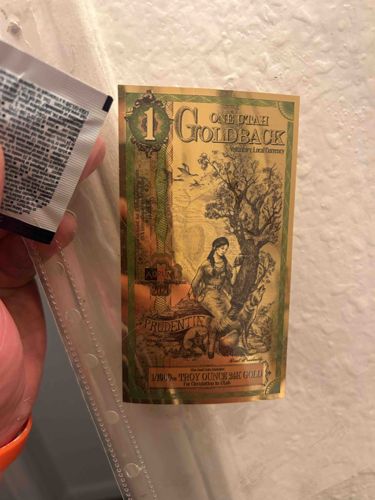
The item is a rectangular piece of 'Valuable Local Currency' made of a thin, gold-colored material, likely gold foil or gilded substrate. Its dimensions appear similar to a standard banknote, approximately 2.5 to 3 inches in width and 5 to 6 inches in height. The overall color scheme is golden with deep green accents and intricate black line work for the illustrations and text. The aesthetic is reminiscent of antique currency or engravings, featuring a classical design.
On the left side, there's a large numeral "1" within an ornate, roughly oval or shield-shaped border, indicating its denomination. The top center boldly displays "ONE UTAH" and "Goldback" in stylized fonts, with "Valuable Local Currency" beneath. The central illustration depicts a female figure, possibly representing a pioneer or allegorical figure, seated beside a large, leafy tree. Behind her, a landscape with birds in flight and what appears to be a structure or monument are visible. A prominent circular feature with a cross or star design and the word "PRUDENTIA" is visible lower left. At the bottom, text reads "1/100th TROY OUNCE 24K GOLD" indicating its intrinsic value and composition.
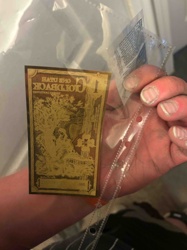
Despite being photographed, the item appears to be in excellent condition, possibly new, and is encased in a clear plastic protective sleeve, suggesting it is being preserved. There are no visible signs of wear, tears, creases, or discoloration. The edges appear crisp and the surface unblemished. The craftsmanship suggests a high degree of precision in its printing and gold-foiling process, emphasizing its role as a valuable and aesthetically pleasing item. The protective sleeve itself has a series of punched holes along the left edge, indicating it might be part of a larger collection or binder.
AI Appraisal Report
I have examined the provided image of a "One Utah Goldback," a piece of Valuable Local Currency. Visually, the item appears to be in superb condition, resembling a new, uncirculated specimen. It is encased in a clear protective sleeve, indicating conscious preservation. The intricate details, sharp printing, and unblemished gold-colored material suggest high manufacturing quality and no visible wear, tears, creases, or discoloration. The '1/100th TROY OUNCE 24K GOLD' inscription indicates its intrinsic gold content.
Goldbacks are recognized alternative currency, and their value is primarily driven by their fractional gold content plus a small premium for their collectibility, artistic design, and the labor involved in their creation. Market conditions show that a 1 Goldback denomination typically trades slightly above its melt value. Comparables for 1 Utah Goldbacks in uncirculated condition generally fall within a tight range. Demand for Goldbacks is niche but steady among collectors, preppers, and those interested in alternative currencies. While unique in concept, the 1 Goldback is not exceptionally rare as it is a standard issue.
The most significant factor impacting its value is its gold content. The '1/100th troy ounce' of 24K gold dictates a substantial portion of its value, with the remainder being a numismatic premium. This premium is relatively stable for common denominations like the 1 Goldback.
Limitations: Based on images alone, I cannot definitively verify the authenticity of the gold content or purity, nor can I fully assess subtle surface imperfections or minute details that might impact grade and value. A physical in-person examination would allow for closer inspection under magnification, a more precise condition assessment, and potentially specific gravity or other non-invasive tests to confirm gold content. Provenance documentation could also support its authenticity and circulation history, though for a modern item like this, it's less critical for value.
Given the visual evidence, excellent condition, and known market for 1 Goldback denominations, I estimate an appraisal value of $4.50-6.00.