AI Appraisal Estimate

AI-generated estimates · not official valuations

From the user

What was submitted

Photo and notes provided by the user — not generated by AI

Submitted item photo
Submitted photo · June 20, 2026

User's notes

No additional notes provided.

AI analysis below

AI appraisal

AI analysis & estimate

AI-Generated · Verify before acting

Everything below is generated by AI for informational purposes only. AI can make mistakes — the AI may misidentify items or misattribute them (artist, maker, brand, designer, origin, era). This is not an official valuation and should not be used for insurance, sale, tax, estate, legal, or lending purposes — or any decision requiring a certified appraisal. It is not an authoritative claim about any person, brand, or rights holder — do not share or rely on it as a factual statement about a third party. Always consult qualified professionals before making financial decisions.

Read the full disclaimer

AI Identification

·Not independently authenticated·Verify before acting

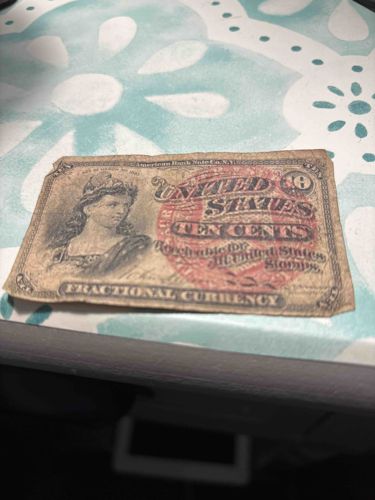
United States Fifth Issue Fractional Currency, Ten Cents (Liberty)

Numismatics / Historical Currency

AI Estimated Value

·Not an official valuation·Verify before acting

$10.00 - $18.00

As of June 20, 2026

AI Item Analysis

·AI can make mistakes·Verify before acting
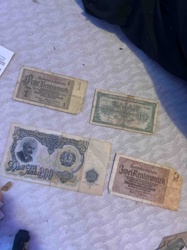
This is a United States Fifth Issue Fractional Currency note with a face value of Ten Cents, originally authorized under the Act of March 3, 1863. This specific series was issued between 1874 and 1876. The front of the note features a detailed engraving of Columbia (or Liberty) on the left side, wearing a Phrygian cap. The center displays 'TEN CENTS' overlaid on a reddish-pink circular seal with intricate lathe work. The text 'Exchangeable for All United States Stamps' and 'FRACTIONAL CURRENCY' is clearly visible. The note was printed by the American Bank Note Co., N.Y., as indicated by the top margin text. Physically, the note is printed on parchment-like paper with a greenish-gray back tint (not fully visible). The condition appears well-circulated (Good to Very Good grade): there are significant signs of aging including heavy foxing, browning/staining, and rounded corners. The edges are frayed and uneven, with various small nicks and creases across the surface. There are no obvious large tears, but the heavy tonality and wear suggest it was handled extensively during the Reconstruction era. The engraving remains legible despite the surface grime, and the red seal retains a faded but distinct color.
AI Appraisal Report

·AI can make mistakes·Verify before acting
I have examined the digital representation of this Fifth Issue 10-cent Fractional Currency note (Friedberg #1264-1266 series). Based on my visual analysis, the note appears to be an authentic specimen from the 1874–1876 issuing period, though its state of preservation is problematic. I grade this note as 'Very Good (VG-8) Details' due to heavy foxing, significant paper toning, and edge fraying. While the engraving of Liberty remains legible and the red seal retains its identity, the overall eye appeal is severely compromised by environmental staining and surface grime. Currently, the market for Fractional Currency is strong for high-grade Choice Uncirculated notes (which can fetch over $100), but common notes in circulated condition like this one are readily available. Its value is primarily historical rather than as a premium numismatic investment. The primary factors suppressing this value are the rounded corners and the 'tanned' appearance of the paper, which suggests exposure to moisture or acidic storage over the last century. Please note that this appraisal is based on digital images alone. A definitive authentication would require a physical inspection to verify the paper's fiber composition and the presence of silk fibers characteristic of this issue. Professional grading by a service such as PMG or PCGS would be necessary to confirm the grade, though the cost of grading would likely exceed the note's market value. No provenance was provided, but these were produced in high volume (over 100 million total across variants), making this a common find for collectors of 19th-century American ephemera.

Get your items appraised

Instant estimates of your treasures with AI-powered appraisals

Browse More Appraisals