AI Appraisal Estimate

AI-generated estimates · not official valuations

From the user

What was submitted

Photo and notes provided by the user — not generated by AI

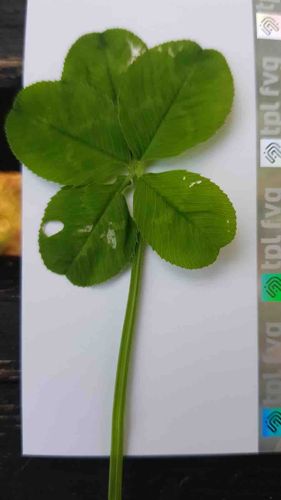
Submitted item photo
Submitted photo · June 1, 2026

User's notes

Five leaf clover found in Opicina, Italy

AI analysis below

AI appraisal

AI analysis & estimate

AI-Generated · Verify before acting

Everything below is generated by AI for informational purposes only. AI can make mistakes — the AI may misidentify items or misattribute them (artist, maker, brand, designer, origin, era). This is not an official valuation and should not be used for insurance, sale, tax, estate, legal, or lending purposes — or any decision requiring a certified appraisal. It is not an authoritative claim about any person, brand, or rights holder — do not share or rely on it as a factual statement about a third party. Always consult qualified professionals before making financial decisions.

Note

This analysis also relies on unverified notes provided by the user, which may be incomplete or inaccurate and could affect the result.

Read the full disclaimer

AI Identification

·Not independently authenticated·Verify before acting

Five-Leaf Clover

Botanical Specimen

AI Estimated Value

·Not an official valuation·Verify before acting

$100-200

As of June 1, 2026

AI Item Analysis

·AI can make mistakes·Verify before acting
This item is a five-leaf clover, a rare botanical anomaly of the white clover plant (Trifolium repens). The specimen exhibits five distinct, heart-shaped leaflets radiating from a central stem. The leaves are a vibrant medium to dark green color, typical of healthy clover foliage, with visible vein patterns. The individual leaflets appear to be intact, though one leaflet on the left side of the image displays a small, irregular hole or tear, suggesting minor damage from environmental factors such as insect activity or physical abrasion. There are also some very small, irregular white or lighter green spots on some of the leaves, possibly indicative of very minor desiccation or surface imperfections. The stem is slender, a lighter green than the leaves, and appears supple, suggesting a relatively fresh specimen rather than a dried or pressed one. There are no discernible maker's marks, signatures, or stamps as this is a natural botanical item. Its estimated age is very recent, likely harvested within a few days to a week based on its apparent freshness. The rarity of five-leaf clovers, being even more uncommon than the traditional four-leaf variety, makes this a unique find. Its quality is good for a natural specimen, with only minor aesthetic imperfections that do not significantly detract from its characteristic appearance.

AI Appraisal Report

·AI can make mistakes·Verify before acting
Upon examining the Five-Leaf Clover, its authenticity as a natural botanical specimen appears evident from the provided image. The distinct heart-shaped leaflets, vibrant green coloration, and naturalistic vein patterns are consistent with Trifolium repens. The minor tear on one leaflet and small surface imperfections are typical of environmental interactions and do not compromise its fundamental authenticity. Its freshness indicates recent harvesting, aligning with the description. Five-leaf clovers are considerably rarer than four-leaf varieties, elevating their uniqueness. While common four-leaf clovers hold novelty value, a five-leaf specimen commands a higher premium due to its extreme scarcity. Market comparables are challenging due to the lack of a formal marketplace for such highly specific natural anomalies. Analogous items might include exceptionally rare botanical specimens traded among collectors or those with unique genetic mutations. Demand for such items is niche, primarily driven by collectors of natural curiosities or individuals seeking symbolic good luck charms. The intrinsic value is derived from its rarity, natural beauty, and the widely held belief in its auspicious properties. Factors impacting value include its intact structure, vibrant color, and the clear distinction of all five leaflets. The minor damage is a slight detractor but does not significantly diminish its overall appeal. It is crucial to note that this appraisal is based solely on the provided image and description. Without physical examination, I cannot definitively verify its three-dimensional integrity, the precise nature of the purported tear, or rule out any subtle artificial alterations. Full authentication would ideally require in-person inspection to assess texture, pliability, and microscopic features. Provenance documentation regarding its discovery in Opicina, Italy, while interesting, does not add to the intrinsic value but rather its narrative. Scientific testing, such as DNA analysis, would be an extreme measure for a botanical item of this type and is typically not warranted unless a dispute over its species or genuine organic nature arises.

Get your items appraised

Instant estimates of your treasures with AI-powered appraisals

Browse More Appraisals