AI estimate as of July 28, 2025 · verify with a professional before acting
AI-Generated · Verify before acting
Everything on this page is generated by AI for informational purposes only. AI can make mistakes — the AI may misidentify items or misattribute them (artist, maker, brand, designer, origin, era). This is not an official valuation and should not be used for insurance, sale, tax, estate, legal, or lending purposes — or any decision requiring a certified appraisal. It is not an authoritative claim about any person, brand, or rights holder — do not share or rely on it as a factual statement about a third party. Always consult qualified professionals before making financial decisions.
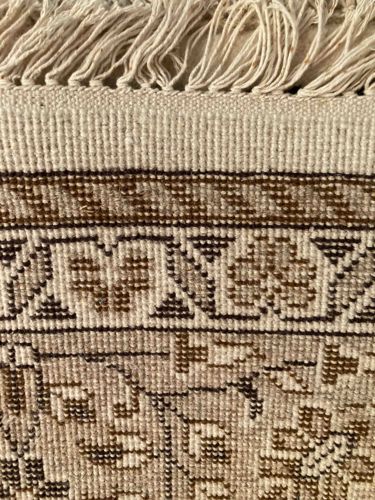
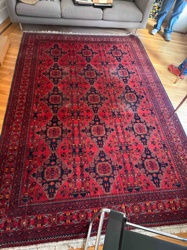
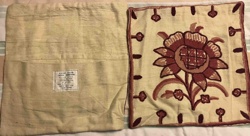
The item is a woven textile, most likely a rug or mat, characterized by a predominantly neutral color palette consisting of various shades of beige, cream, and brown. The visible section reveals a tightly woven structure with a flat, low pile or kilim-style construction. The top edge features an exposed fringe of undyed, light-colored fibers, indicating the warp threads. Below the fringe, there is a distinct border in a lighter beige, followed by a band of darker brown that serves as a transition to the main patterned field. The patterning is geometric and consists of intricate, pixelated motifs typical of some traditional weaving styles. These motifs include triangular shapes, crosses, and possibly stylized floral or abstract elements, all rendered in shades of light brown and dark brown against the beige background. The density of the weave appears to be quite high, suggesting good craftsmanship and durability. There are no obvious signs of significant wear, tears, or major staining in the visible area, indicating the item is in good to very good condition. The colors appear consistent and unfaded. The regular and consistent knotting or weaving suggests a hand-woven piece, though machine-made textiles can sometimes mimic this appearance. The overall aesthetic points towards a traditional or ethnic-inspired design, possibly from a Middle Eastern, Central Asian, or Southwestern American origin, though without more context, a precise manufacturing origin or style period is difficult to ascertain. However, the use of earth tones and geometric patterns is timeless and suggests it could be contemporary or vintage.
AI Appraisal Report
I have examined the provided image of this Geometric Pattern Woven Textile, which appears to be a rug or mat fragment. Visually, the piece is in good to very good condition, showing no apparent tears, significant wear, or major staining. The colors are consistent, and there's no visible fading. The tightly woven structure, flat low pile (or kilim-style), and visible warp fringes suggest a high degree of craftsmanship, leaning towards a hand-woven construction, although precise authentication without physical inspection is challenging.
My assessment of authenticity via image alone is limited. While the density and regularity of the weave hint at handcraftsmanship, some high-quality machine weaves can mimic this. To fully authenticate, I would need to physically inspect the knotting/weaving technique, fiber type, and dye penetration. Provenance documentation (origin, age, maker) would also be crucial. Scientific testing of fibers or dyes could definitively confirm age and origin.
Market conditions for geometric patterned textiles, especially those in neutral earth tones, remain consistently strong due to their versatility in various decor styles. Comparables would include hand-woven kilims or flat-weave rugs from various regions (e.g., Turkish, Persian, Southwestern Native American) of similar size and condition. Demand for such pieces is steady, as they offer timeless aesthetic appeal. Factors impacting value significantly include whether it is indeed hand-woven, its specific origin (some regions command higher prices), and its age. As a fragment, its value is inherently lower than a complete rug.
Without physical inspection and provenance, precise identification is impossible; thus, the valuation leans towards a decorative textile piece rather than a collectible antique of known origin.