AI estimate as of December 1, 2025 · verify with a professional before acting
AI-Generated · Verify before acting
Everything on this page is generated by AI for informational purposes only. AI can make mistakes — the AI may misidentify items or misattribute them (artist, maker, brand, designer, origin, era). This is not an official valuation and should not be used for insurance, sale, tax, estate, legal, or lending purposes — or any decision requiring a certified appraisal. It is not an authoritative claim about any person, brand, or rights holder — do not share or rely on it as a factual statement about a third party. Always consult qualified professionals before making financial decisions.
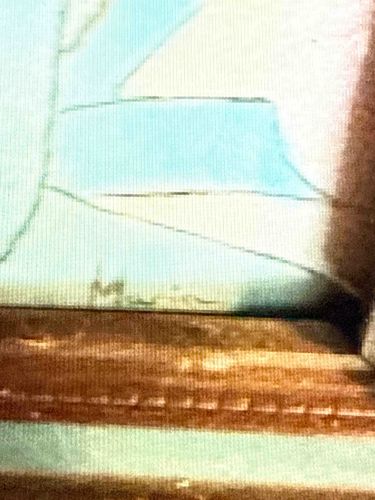
The item depicted appears to be a section of a textile object, possibly a piece of furniture, a wall hanging, or a decorative panel. The textile features an abstract geometric pattern with dominant colors of light blue, cream, and possibly hints of light green or yellow, suggesting a cool or muted color palette. The pattern consists of broad, angular shapes with thin, darker lines defining their edges, reminiscent of stained glass or mosaic art. The texture of the fabric is visible, showing a slightly ribbed or woven quality, consistent with a textile material. The image primarily focuses on the lower portion of the textile, where it meets a substantial wooden element. This wooden component exhibits a rich, warm brown color with visible wood grain, indicating a natural material. The surface of the wood section appears to be a flat, horizontal plane, possibly the top surface of a frame, a shelf, or a structural support. There are faint parallel lines or grooves along the length of the wooden piece, which could be part of its construction, decorative detailing, or perhaps wear patterns. The connection between the textile and the wood is not explicitly clear, but it seems to be a border or frame. Given the blurred quality and limited scope of the image, precise manufacturing details or maker's marks are not discernible. The overall aesthetic suggests a modern or contemporary style, possibly mid-20th century onwards, due to the abstract nature of the design and the relatively clean lines. The condition appears to be fair to good, with no obvious signs of significant damage or repair. However, the resolution of the image makes it challenging to assess minor wear or patina on either the textile or the wood.
AI Appraisal Report
Based on my visual examination of the provided image, the textile art/decorative object, an 'Abstract Pattern Textile with Wooden Base,' appears to be in fair to good condition. The textile exhibits a geometric abstract pattern in a cool palette of light blue, cream, and possibly subtle greens/yellows, suggesting a modern or contemporary aesthetic, potentially mid-20th century or later. The visible woven texture is consistent with a textile material. The wooden base is a warm brown with discernible grain, indicating a natural wood component. I note no overtly significant damage or repair, though the image resolution limits detailed assessment of minor wear, fading, or patina.
Authenticity verification is highly limited from images alone. I cannot determine the specific type of fabric, dye quality, or the wood species and construction methods without in-person examination. Provenance documentation, such as artist signatures, labels, or purchase records, would be crucial for attributing the piece to a specific artist or manufacturer and establishing its age definitively. Without such information, it is difficult to accurately date or attribute the piece, which significantly impacts its market value. Scientific testing of materials could further inform authenticity and age.
Market conditions for abstract textiles and decorative objects vary widely based on artist recognition, age, and uniqueness. In the current market, decorative abstract textiles without clear attribution or provenance typically command modest prices. Comparables fall into a broad range, from mass-produced decorative items to unique artistic pieces, rendering a direct comparison challenging. Demand for well-executed abstract designs is generally stable, but rarity for this specific item is unquantifiable without further information. Factors significantly impacting value include the potential for artist attribution, the quality of materials (e.g., hand-loomed textile, exotic wood), and the overall craftsmanship, none of which can be thoroughly assessed from this image. Given these limitations and assuming it is a decorative rather than a fine art piece, my appraisal reflects its current standing as an attractive, but unauthenticated, decorative object.