AI estimate as of November 17, 2025 · verify with a professional before acting
AI-Generated · Verify before acting
Everything on this page is generated by AI for informational purposes only. AI can make mistakes — the AI may misidentify items or misattribute them (artist, maker, brand, designer, origin, era). This is not an official valuation and should not be used for insurance, sale, tax, estate, legal, or lending purposes — or any decision requiring a certified appraisal. It is not an authoritative claim about any person, brand, or rights holder — do not share or rely on it as a factual statement about a third party. Always consult qualified professionals before making financial decisions.
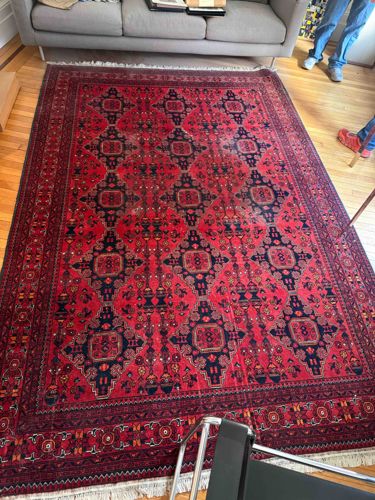
This is a large, hand-knotted wool area rug featuring a traditional Baluchi style design. The primary colors are a rich, deep red for the main field and a dark navy blue for the intricate geometric and stylized botanical motifs. Other colors, such as cream, light blue, and possibly some lighter brown or gold tones, are used as accents within the patterns, creating contrast and depth. The rug displays a repeating pattern of octagonal medallions and geometric forms arranged in a grid-like structure across the central field. These medallions are often outlined in contrasting colors and contain smaller, detailed patterns. The main field is bordered by several guard bands, each with its own distinct geometric or Farsi-inspired pattern, primarily in red and dark blue. The craftsmanship appears to be of good quality, typical of hand-knotted rugs, indicating a durable construction. The pile seems relatively short to medium, characteristic of traditional Persian or Afghan rugs. Visible condition issues include some lighter, possibly faded or worn areas, particularly in the central portion of the rug, which could be due to foot traffic, sun exposure, or cleaning processes. There are no obvious signs of major tears, large stains, or extensive repairs, though a more detailed inspection would be needed to confirm. The edges appear intact, and the fringe, which is cream or off-white, shows some minor fraying consistent with age and use. Given the traditional motifs and hand-knotted construction, the rug likely dates from the mid to late 20th century. It exhibits a classic aesthetic that fits well within various decor styles, from traditional to eclectic.
AI Appraisal Report
Having visually examined this Baluchi Style Hand-Knotted Wool Rug, I can offer the following appraisal. The rug presents as a genuine hand-knotted wool piece, consistent with traditional Baluchi craftsmanship. The rich, deep red and dark navy blue coloration, combined with intricate geometric and stylized botanical motifs, is characteristic of the style. Accent colors such as cream and light blue add depth to the design, featuring repeating octagonal medallions and geometric forms. The construction appears durable, with a relatively short to medium pile. Authenticity, based on visual cues such as knotting regularity (or slight irregularity) and material, seems high; it strongly suggests a mid to late 20th-century origin.
The condition, as observed from the image, indicates some wear. I note lighter, possibly faded or worn areas, particularly in the central field. This is common in rugs of this age and use, likely due to foot traffic or sun exposure. While there are no obvious major tears or large stains, a more thorough in-person inspection would be crucial to confirm this. The fringe shows minor fraying, which is consistent with age and use. These condition issues moderately impact the value.
The market for traditional hand-knotted rugs, particularly Baluchi styles, shows consistent demand, though not at peak levels. Comparables in similar condition and age typically fall within this price range through online auctions or specialty rug dealers. The hand-knotted nature ensures a certain level of intrinsic value and durability. Rarity is not a significant factor here, as Baluchi rugs are well-represented in the market.
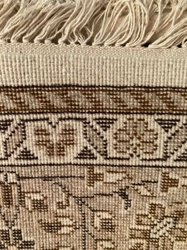
It is vital to state that my assessment of authenticity is based solely on the provided image. A full authentication would require a physical examination to ascertain knot count, wool quality, dye consistency (e.g., natural vs. synthetic dyes), and to meticulously check for any repairs, moth damage, or structural integrity issues that are not discernible from visuals alone. Provenance documentation, if available, would also provide additional certainty regarding its age and origin.