AI estimate as of August 9, 2025 · verify with a professional before acting
AI-Generated · Verify before acting
Everything on this page is generated by AI for informational purposes only. AI can make mistakes — the AI may misidentify items or misattribute them (artist, maker, brand, designer, origin, era). This is not an official valuation and should not be used for insurance, sale, tax, estate, legal, or lending purposes — or any decision requiring a certified appraisal. It is not an authoritative claim about any person, brand, or rights holder — do not share or rely on it as a factual statement about a third party. Always consult qualified professionals before making financial decisions.
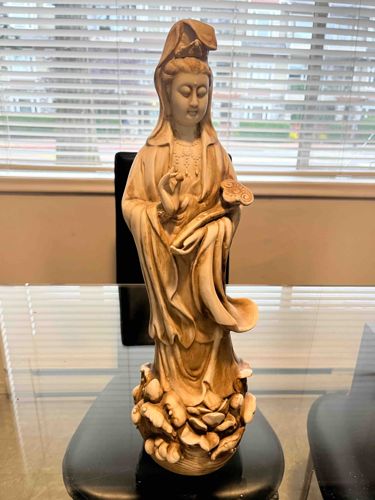
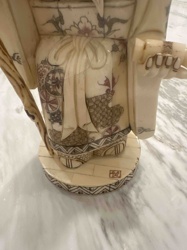
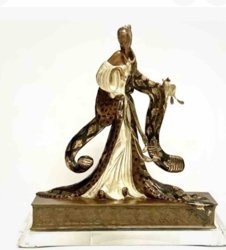
This is a full-standing statue depicting Guanyin (also known as Avalokiteshvara), the bodhisattva associated with compassion. The statue appears to be made from a resin composite or a type of reconstituted stone, designed to mimic the appearance of aged ivory, bone, or perhaps a natural mineral. Its color is a uniform off-white or cream, with darker recesses suggesting intentional antique patination to enhance the sculptural details and give it an older, weathered look. The figure is draped in flowing robes, intricately carved to show soft folds and movement, particularly around the lower body and arms. The hands are positioned in a symbolic mudra; the right hand is raised slightly, fingers delicately poised, while the left hand holds a ceremonial object, possibly a ruyi scepter or a stylized cloud, which is often associated with auspiciousness and wish-fulfillment. The facial features are serene and idealized, with downcast eyes, a gentle smile, and elongated earlobes indicative of wisdom and spiritual enlightenment. The detailed carving extends to the headwear, which is elaborate and appears to be sculpted as part of the overall piece rather than a separate attachment. The base of the statue is robustly sculpted with flowing water, lotus petals, or perhaps stylized clouds, providing a stable foundation and adding to the thematic narrative of purity, enlightenment, and the bodhisattva's association with the sea. There are no obvious signs of significant damage like chips, cracks, or repairs visible from the provided images, though a closer inspection would be required to confirm this. The overall craftsmanship suggests a mass-produced or semi-mass-produced decorative item, likely from the 20th or 21st century, rather than an antique hand-carved piece. The quality of the molding and finish is consistent, showing good attention to detail in the drapery and iconography.
AI Appraisal Report
Upon examining the provided image of this Guanyin Bodhisattva statue, I assess its condition as excellent, showing no obvious chips, cracks, or repairs. Its authenticity as an antique, however, is questionable. The uniform off-white color, coupled with the intentional patination in recesses, strongly suggests manufacture from a resin composite or similar reconstituted stone, designed to emulate aged ivory or bone. This is a common characteristic of mass-produced or semi-mass-produced decorative items from the late 20th or 21st century, rather than a genuine antique hand-carved piece. The consistent quality of molding and finish further supports this assessment. Market conditions for such decorative religious figures are generally stable but do not command high prices. Comparables indicate that similar resin or composite statues, even those with intricate detail, typically retail in the lower to mid-range of the decorative art market. Demand exists primarily from collectors of Asian statuary or individuals seeking decorative spiritual items, but rarity is low due to common manufacturing. Factors impacting value negatively include its likely modern composite material and probable mass-production. For full authentication and to definitively rule out a more valuable material or age, an in-person examination, including tactile inspection to assess material composition, precise weight, and detailed surface analysis for tool marks or mold lines, would be essential. Provenance documentation, if available, would also be critical. Without physical inspection, I cannot confirm the material beyond visual inference.