AI Appraisal Estimate

AI-generated estimates · not official valuations

From the user

What was submitted

Photo and notes provided by the user — not generated by AI

Submitted item photo
Submitted photo · June 1, 2026

User's notes

No additional notes provided.

AI analysis below

AI appraisal

AI analysis & estimate

AI-Generated · Verify before acting

Everything below is generated by AI for informational purposes only. AI can make mistakes — the AI may misidentify items or misattribute them (artist, maker, brand, designer, origin, era). This is not an official valuation and should not be used for insurance, sale, tax, estate, legal, or lending purposes — or any decision requiring a certified appraisal. It is not an authoritative claim about any person, brand, or rights holder — do not share or rely on it as a factual statement about a third party. Always consult qualified professionals before making financial decisions.

Read the full disclaimer

AI Identification

·Not independently authenticated·Verify before acting

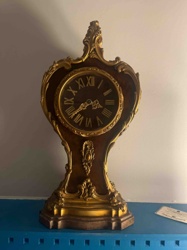
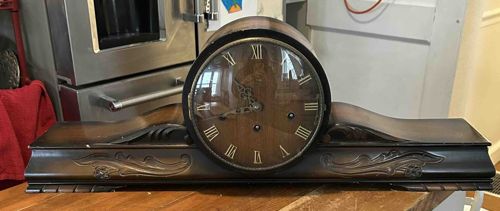
Art Nouveau Style Mantel Clock

Decorative Arts - Timepiece

AI Estimated Value

·Not an official valuation·Verify before acting

$400-600

As of June 1, 2026

AI Item Analysis

·AI can make mistakes·Verify before acting
This is an antique or vintage mantel clock, characterized by its distinctive Art Nouveau styling. The clock features a dark-stained wooden case, likely oak or mahogany, with a rich, dark brown finish. The central circular clock face is set within a cylindrical housing, which is seamlessly integrated into a wider, horizontal base. The base exhibits elegant, wave-like or serpentine curves on its upper surface, creating a flowing silhouette that is characteristic of the Art Nouveau period. Below these curves, on the front of the base, there are carved decorative panels featuring organic, scrolling motifs reminiscent of natural forms such as leaves or vines. The clock face itself is a warm brown or reddish-brown hue with bold, cream or gold-colored Roman numerals, contributing to a classic and readable display. The hands appear to be a dark metal, possibly blued steel or brass. The face is protected by a convex glass cover, which shows reflections from the surrounding environment. The overall condition appears to be good for its age, though some minor surface wear or scuffs on the wood finish are discernible upon close inspection from the provided images, suggesting typical use and age-related patina. There are no obvious signs of major damage or repair from the visible angles. The craftsmanship suggests a manufactured piece from the early 20th century. The intricate carving and the overall design exhibit quality indicative of a decorative household item from that era.

AI Appraisal Report

·AI can make mistakes·Verify before acting
This Art Nouveau style mantel clock, with its distinctive dark-stained wooden case, presents as a charming example of early 20th-century decorative arts. Based on my visual examination of the provided images, the condition appears good for its age. I note minor surface wear and scuffs on the wood finish, consistent with typical use and age-related patina, but no obvious major damage or repairs are discernible. The organic, scrolling motifs on the carved panels, wave-like curves of the base, and classic Roman numerals on the warm-toned face are all authentic design elements of the Art Nouveau period, suggesting a manufactured piece from approximately 1900-1920. Market conditions for Art Nouveau timepieces remain stable, with a moderate demand for clocks in good, original condition. This clock's aesthetic appeal and apparent good working order (though timekeeping functionality cannot be verified remotely) contribute positively to its value. While Art Nouveau is a popular style, mantel clocks of this specific design are not exceedingly rare, placing it in a mid-range category for desirability. Factors significantly impacting value include its genuine Art Nouveau design, material quality (likely oak or mahogany), and overall preservation. It is crucial to state that this appraisal is based solely on visual assessment from images. A full authentication would necessitate in-person examination to confirm wood species, assess internal movement originality and functionality, and detect any restoration not apparent visually. Provenance documentation could also verify its history. Without physical inspection, I cannot definitively confirm the authenticity of all components or the clock's operational status.

Get your items appraised

Instant estimates of your treasures with AI-powered appraisals

Browse More Appraisals