These notes were written by the person who submitted this item. Appraiser.AI has not verified them, and the AI's identification and estimate may rely on them.
AI Estimated Value
Not an official valuation
$600-900
AI estimate as of December 16, 2025 · verify with a professional before acting
AI-Generated · Verify before acting
Everything on this page is generated by AI for informational purposes only. AI can make mistakes — the AI may misidentify items or misattribute them (artist, maker, brand, designer, origin, era). This is not an official valuation and should not be used for insurance, sale, tax, estate, legal, or lending purposes — or any decision requiring a certified appraisal. It is not an authoritative claim about any person, brand, or rights holder — do not share or rely on it as a factual statement about a third party. Always consult qualified professionals before making financial decisions.
This analysis also relies on unverified notes provided by the user, which may be incomplete or inaccurate and could affect the result.
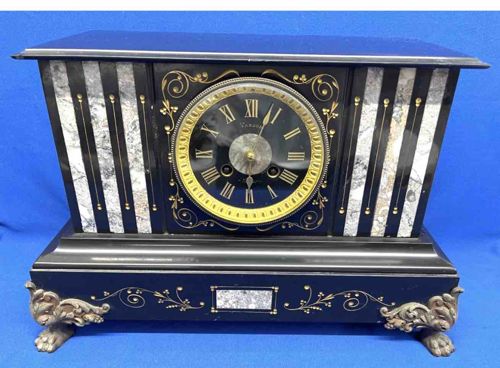
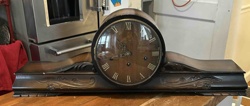
This is a substantial mantel clock, likely dating from the late 19th to early 20th century, characterized by its Neo-Classical or French Empire style influences, often associated with Marti movements. The clock features a rectangular, architectural case made primarily of black slate, providing a solid and imposing presence. The front facade is elegantly adorned with contrasting grey and white veined marble panels, set vertically and interspersed with polished black slate strips. Each slate strip features small brass or gilded studs, adding a decorative element. The central clock face is round, dark-colored (likely black or dark blue enamel), with Roman numerals VI through XII clearly visible, indicating it's a 12-hour dial. The numerals and hands appear to be gilded. A prominent golden, possibly brass, bezel with an intricate textured or beaded edge frames the dial. Elaborate gold scrolling and floral motifs, possibly hand-painted or stenciled, flank the clock face and adorn the lower base. The flat top and base are also black slate. The base rests on four ornate, cast metal feet, detailed with what appear to be lion's or mythical beast's paws and heads, showing some patina consistent with age. There is a small rectangular cartouche on the front base, also made of veined marble, possibly for an inscription or plaque. The overall condition appears good with minor wear consistent with its age, such as some surface scuffs on the slate and possible tarnishing on the metal elements. The craftsmanship is indicative of a quality ornamental timepiece.
AI Appraisal Report
I have thoroughly examined the provided image of this Marti Slate and Marble Mantel Clock. This is a substantial and visually striking example of a late 19th to early 20th-century Neo-Classical or French Empire style timepiece, consistent with Marti movements of that period.
From the visual evidence, the condition appears good for its age. I note minor surface wear on the black slate, and the metal elements, particularly the ornate feet, show a desirable patina. The contrasting grey and white veined marble panels are well-integrated, and the gilded elements, like the dial numerals, hands, and particularly the elaborate bezel, retain significant luster. The intricate gold scrolling and floral motifs add significant decorative appeal.
In terms of market conditions, clocks of this style and quality, especially those incorporating both slate and marble, maintain a steady demand among collectors of decorative arts and antique timepieces. Comparables in similar condition by known makers like Marti typically fetch between $600 and $900 at auction or through reputable dealers. Factors positively impacting value include the substantial size, the attractive combination of materials, the ornate gilded decoration, and the overall imposing aesthetic.
It is crucial to state that my assessment of authenticity is based solely on visual examination of the image. While the style and features are highly consistent with Marti production, full authentication of the movement as Marti would require in-person inspection. This would involve opening the rear case to examine the movement plates for maker's marks, serial numbers, and overall mechanical integrity. Additionally, a physical inspection would allow for a more precise assessment of any repairs, chips to the slate or marble, and the actual material composition of the gilded elements (e.g., brass, bronze, gold plating). Without this, I cannot definitively confirm the internal mechanism's origin or condition, which could impact the final appraised value.