AI estimate as of September 3, 2025 · verify with a professional before acting
AI-Generated · Verify before acting
Everything on this page is generated by AI for informational purposes only. AI can make mistakes — the AI may misidentify items or misattribute them (artist, maker, brand, designer, origin, era). This is not an official valuation and should not be used for insurance, sale, tax, estate, legal, or lending purposes — or any decision requiring a certified appraisal. It is not an authoritative claim about any person, brand, or rights holder — do not share or rely on it as a factual statement about a third party. Always consult qualified professionals before making financial decisions.
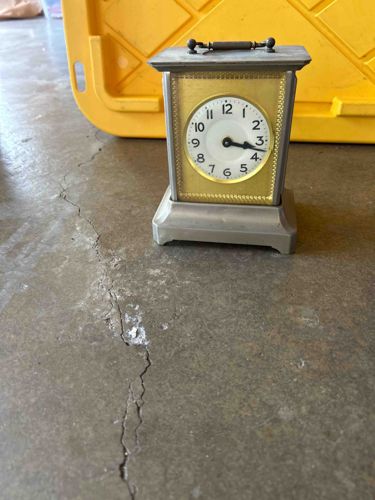
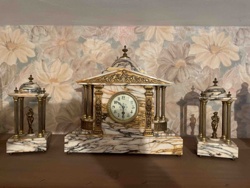
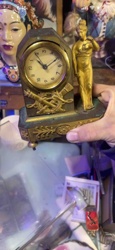
This is a small, rectangular mantel or desk clock, likely dating from the early to mid-20th century. Its overall construction appears to be of metal, possibly brass with a grey-tone finish for the main body and top, contrasted with a golden-yellow colored central panel on the front. The clock features a classic, minimalist design, with a square face set within a rectangular frame. The clock face itself is round with a white background, black Arabic numerals, and simple black hour and minute hands. There is no second hand visible. The golden panel surrounding the clock face is adorned with a raised, beaded or rope-like trim on all four sides, adding a decorative element. On the top of the clock, there is a small, ornate handle or finial, suggesting portability or a design influence from carriage clocks. The base of the clock is wider than the body, providing stability, and flares out slightly at the bottom edges. The grey finish on the non-golden sections exhibits some signs of wear and patina consistent with age, though no significant damage like dents or large scratches are immediately apparent from the image. The brass or gold-colored face surround shows some potential tarnishing or age-related discoloration, which is typical for metallic objects over time. The craftsmanship appears to be reasonably good for a mass-produced item of its era, with clean lines and uniform decorative elements. No specific manufacturer's marks or signatures are visible in the provided image.
AI Appraisal Report
I have examined the provided image of this vintage mantel/desk clock, assessing its condition and potential value. The clock appears to be a well-preserved example from the early to mid-20th century, likely of American or European manufacture. Its condition is consistent with age, showing expected wear and patination on the grey-toned metal and potential tarnishing on the brass/gold-colored elements. No significant damage such as dents or deep scratches are visible, which bodes well for its decorative appeal.
Authenticity, based solely on visual examination, suggests it is an period piece, not a modern reproduction. The design elements, material appearance, and apparent craftsmanship align with clocks of that era. However, without physical inspection, I cannot confirm the originality of all components or rule out any past repairs. An in-person examination would allow for closer inspection of the movement, the integrity of the casing, and any manufacturer's marks which are not visible in the image. Provenance documentation, if available, would significantly enhance authentication.
The market for vintage mantel/desk clocks is moderately active. These pieces are sought after for their aesthetic appeal and functional charm, often by collectors of decorative arts or individuals furnishing period-style interiors. This particular clock, while attractive with its contrasting finishes and beaded trim, is not exceptionally rare. Comparables in similar condition typically fetch prices in the indicated range, reflecting steady but not explosive demand. Factors impacting value include the movement's functionality (which cannot be assessed from an image), the exact materials used (e.g., solid brass vs. plated), and the presence of any reputable maker's marks.
To definitively appraise, I would need to physically inspect the clock, assess the movement's condition and working order, verify its originality, and look for any hidden maker's signs or stamps. This would allow for a more precise valuation.