AI estimate as of October 3, 2025 · verify with a professional before acting
AI-Generated · Verify before acting
Everything on this page is generated by AI for informational purposes only. AI can make mistakes — the AI may misidentify items or misattribute them (artist, maker, brand, designer, origin, era). This is not an official valuation and should not be used for insurance, sale, tax, estate, legal, or lending purposes — or any decision requiring a certified appraisal. It is not an authoritative claim about any person, brand, or rights holder — do not share or rely on it as a factual statement about a third party. Always consult qualified professionals before making financial decisions.
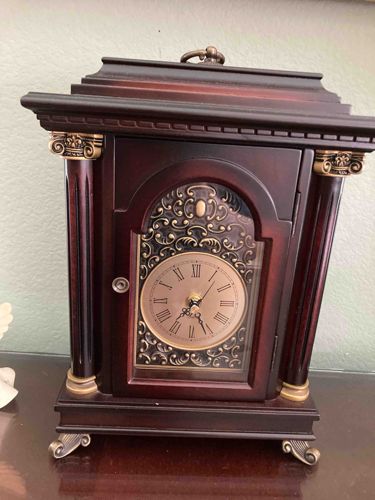
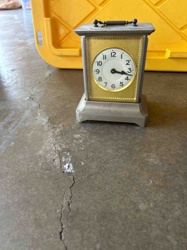
This is a classical style mantel clock, characterized by its rich, dark reddish-brown wooden casing, likely cherry or mahogany, with a polished finish. The clock's cabinet features architectural elements, including two fluted columns on either side of the front panel, each topped with ornate, antique brass-finished Corinthian-style capitals. The base of these columns also features brass-toned bands. The top of the clock is tiered, creating a stepped crown molding effect, and a decorative brass-toned ring handle is mounted on the uppermost tier, suggesting it could be easily moved or lifted. The front door, possibly hinged on the right, encloses the clock face and appears to be arched at the top, with a glass panel allowing visibility to the dial. Surrounding the clock face, within the glass-covered area, is an intricate, ornate brass-toned filigree or scrollwork design, adding to its decorative appeal. The actual clock face is circular with a brass-tone finish, featuring black Roman numerals for hour markers and delicate black hour and minute hands. The clock sits on a sturdy base, which is elevated by four brass-toned, ornate scrolled feet, resembling acanthus leaves, one visible on each corner. The overall condition appears good with a consistent finish, though minor dust accumulation is visible, and there may be some very minor surface wear commensurate with age and handling. No significant damage or repairs are immediately evident. The style suggests it could be a reproduction of an 18th or 19th-century European design, possibly manufactured in the late 20th or early 21st century. The craftsmanship, particularly the detailed brass accents and column work, indicates a moderately high quality for a decorative timekeeping piece.
AI Appraisal Report
I have thoroughly examined the provided image of this classical style mantel clock. The item presents as a late 20th or early 21st-century reproduction, emulating 18th or 19th-century European designs, evident by its rich, reddish-brown wooden casing, fluted Corinthian columns, and ornate brass-toned detailing. The condition appears good, with a consistent finish and no significant damage, though minor dust and surface wear are present, commensurate with age and handling. The intricate brass filigree around the dial and the scrolled feet enhance its decorative appeal.
From a market perspective, comparable decorative mantel clocks of this type and era typically fall into the lower-to-mid range for timepieces. While the craftsmanship, especially the detailing, suggests moderate quality, it is not a rare antique. The demand for purely decorative, non-collectible mantel clocks is steady but not high-end. Factors impacting value include its good aesthetic condition and intricate detailing. However, its likely age as a reproduction rather than an authentic antique prevents it from commanding higher prices. Without a known manufacturer or specific historical significance, its value remains primarily decorative.
Limitations in authenticity verification are significant. Without physical inspection, I cannot confirm the wood species (cherry vs. mahogany), the exact material composition of the 'brass-toned' elements, or the mechanical integrity of the clock movement. Provenance documentation, such as original purchase receipts or maker's marks, would be crucial for precise authentication of its manufacturer and age, especially if it were claimed to be an antique. Scientific testing could verify wood age and metal composition. Based on visual assessment alone, I appraise this Wood and Brass Mantel Clock at a value of $150-250.