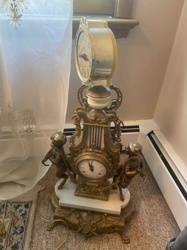
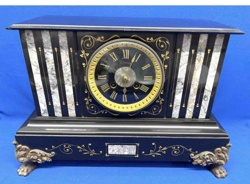
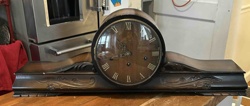
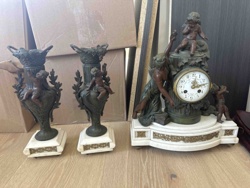
These notes were written by the person who submitted this item. Appraiser.AI has not verified them, and the AI's identification and estimate may rely on them.
AI Estimated Value
Not an official valuation
$600-900
AI estimate as of July 15, 2025 · verify with a professional before acting
AI-Generated · Verify before acting
Everything on this page is generated by AI for informational purposes only. AI can make mistakes — the AI may misidentify items or misattribute them (artist, maker, brand, designer, origin, era). This is not an official valuation and should not be used for insurance, sale, tax, estate, legal, or lending purposes — or any decision requiring a certified appraisal. It is not an authoritative claim about any person, brand, or rights holder — do not share or rely on it as a factual statement about a third party. Always consult qualified professionals before making financial decisions.
This analysis also relies on unverified notes provided by the user, which may be incomplete or inaccurate and could affect the result.
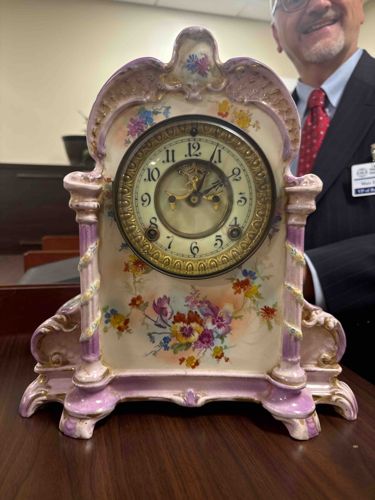
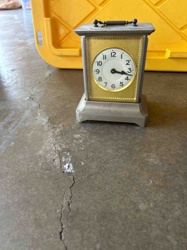
This item is an antique Ansonia porcelain mantel clock, likely dating from the late 19th century based on the 'patent 1884' context. The clock features an ornate porcelain case, predominantly off-white or cream in color, with significant hand-painted floral embellishments. The floral motifs are vibrant and include a variety of blossoms and foliage in shades of purple, pink, orange, yellow, and blue, suggesting a naturalistic, somewhat impressionistic style. The top, base, and structural elements like the columns and feet are highlighted with a soft, faded lavender or pale purple color, accented with gold gilt details, particularly along the edges and raised decorative elements. The overall form is classical with a decorative pediment at the top, two fluted columns flanking the clock face, and a stepped base with four scroll-like feet. The clock face itself is white porcelain or enamel with black Arabic numerals and intricate gold-toned hands, including a subsidiary dial that is partially visible. The brass bezel surrounding the clock face is highly decorative, featuring a finely detailed patterned edge, indicating quality craftsmanship. Visible condition aspects include general wear consistent with age, particularly some fading or minor chipping of the gold gilt, and potential crazing in the porcelain although not clearly discernible from the image. The porcelain appears to be in good overall condition with no obvious cracks or large chips. The design aesthetic suggests a Rococo Revival or Aesthetic Movement influence, appealing to the tastes of the period for decorative and functional objects. The combination of delicate porcelain, rich color palette, and intricate details signifies a higher quality piece.
AI Appraisal Report
Based on my visual examination of the provided image, this Ansonia porcelain mantel clock, marked 'patent 1884', appears to be an authentic late 19th-century example. The distinctive design, including the classical form with columns and pediment, elaborate floral painting, and decorative gilt accents, is highly consistent with Ansonia's output during the Aesthetic Movement/Rococo Revival period. The visible "patent 1884" aligns perfectly with their known production dates for such porcelain cased clocks.
In terms of condition, the porcelain body appears significantly intact with no obvious large cracks or chips, which is a major positive. Minor fading or chipping of the gold gilt is expected for an item of this age and does not significantly detract from value. The vibrancy of the floral decoration is well-preserved. While not clearly discernible from the image, I would look for hairline cracks or crazing during a physical inspection, which are common in antique porcelain but can impact value depending on severity. The functionality of the clock mechanism cannot be assessed from an image, and a non-working movement would necessitate repair, impacting the net value.
Market conditions for antique porcelain mantel clocks, particularly well-preserved Ansonia examples, remain fairly steady. There is consistent demand from collectors of decorative arts and horology, though the peak of the market for mass-produced antique clocks has passed. Comparable sales for similar Ansonia porcelain mantel clocks in good to very good condition typically range from $300 to $700. The detailed floral decoration and intricate brass bezel on this specific example elevate its aesthetic appeal, placing it at the higher end of this range. Rarity is moderate; while Ansonia produced many clocks, exceptionally well-preserved and aesthetically pleasing examples like this are less common.
Factors significantly impacting value include the overall intactness of the porcelain case, the quality and preservation of the hand-painted decoration, and the operational status of the movement. The attractive floral motif and the clear Ansonia identification enhance its collectibility. Limitations in authenticity verification from images alone exist; I cannot confirm the originality of the movement to the case, nor can I thoroughly inspect for subtle repairs or condition issues like internal cracks or extensive crazing. A physical inspection would allow me to verify the movement's serial numbers and Ansonia markings, confirm the absence of restoration, and assess the true extent of wear and tear. Provenance documentation, if available, would further strengthen authentication.