AI estimate as of September 2, 2025 · verify with a professional before acting
AI-Generated · Verify before acting
Everything on this page is generated by AI for informational purposes only. AI can make mistakes — the AI may misidentify items or misattribute them (artist, maker, brand, designer, origin, era). This is not an official valuation and should not be used for insurance, sale, tax, estate, legal, or lending purposes — or any decision requiring a certified appraisal. It is not an authoritative claim about any person, brand, or rights holder — do not share or rely on it as a factual statement about a third party. Always consult qualified professionals before making financial decisions.
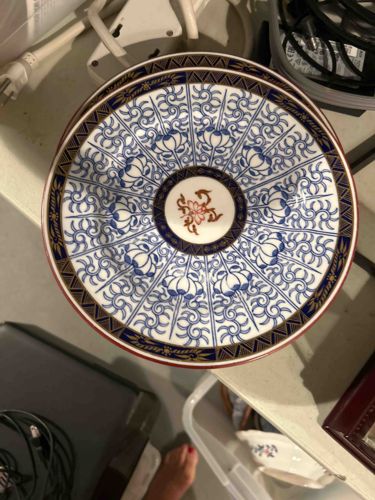
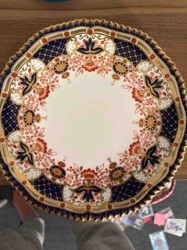
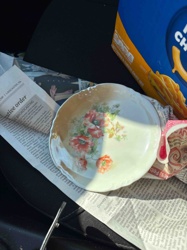
This appears to be a decorative ceramic plate, likely porcelain or fine china, exhibiting intricate patterns and vibrant colors. The dominant colors are cobalt blue, white, gold, and a reddish-brown or rust color. The plate features a central medallion with a motif resembling a stylized floral design, possibly a peony or chrysanthemum, rendered in reddish-brown and gold accents against a dark blue ring. Surrounding this central design, the plate features a radiating pattern of white panels filled with elaborate blue scrollwork, often incorporating lotus-like floral elements. Each panel is separated by narrow, dark blue lines. Towards the rim, there is a band of dark blue with gold scrollwork, followed by an outer border of alternating gold and dark blue zigzag or triangular patterns. The very edge of the rim appears to have a subtle reddish-brown or terra cotta color. The overall craftsmanship suggests a high level of detail, possibly hand-painted or meticulously applied transferware, with clear, crisp lines and rich color saturation. The specific style, with its heavy reliance on blue and white patterns, red highlights, and gold accents, is highly suggestive of Imari ware or a similar Japanese/Asian ceramic style, possibly from the late 19th to mid-20th century. Visible condition appears to be good, with no obvious chips, cracks, or significant wear to the glaze or painted surfaces, though a full assessment would require viewing the base and edges. The patterns are well-defined, indicating good quality production, and the design elements are symmetrical and balanced.
AI Appraisal Report
Upon my virtual examination of this Imari Style Decorative Plate, I find its aesthetic qualities to be quite strong. The vibrant cobalt blue, white, gold, and reddish-brown palette is characteristic of traditional Imari ware, suggesting either Japanese origin or a European imitation. The intricate scrollwork, stylized florals, and paneling are meticulously rendered, indicating a good quality of craftsmanship, likely hand-painted or a high-quality transferware with hand-finishing. Visually, the condition appears excellent; I observe no apparent chips, cracks, or significant loss to the glaze or painted details. This pristine visual condition significantly contributes to its current market appeal.
However, it is crucial to note the limitations of image-based appraisal. While the style strongly suggests Imari, definitive authenticity as true antique Japanese Imari ware cannot be confirmed without in-person examination. I would need to inspect the base for marks, footring, and inherent imperfections that reveal age and origin. Provenance documentation, such as collection history or original purchase receipts, would also be invaluable. Scientific testing of glazes or pottery composition could further verify age and origin, but is typically beyond the scope of a standard appraisal.
Based on comparable sales of similar high-quality decorative Imari-style plates from the late 19th to mid-20th century, assuming modern decorative rather than truly antique significance, the demand remains steady for aesthetically pleasing examples in excellent condition. Rarity is moderate, as many such pieces were produced. Factors impacting value positively include the superb visual condition and intricate design. The primary unknown, and thus the limiting factor on a higher valuation, is the lack of physical authentication. Without confirmation of age, maker, and true origin, it is valued more as a decorative item than a collectible antique.