AI estimate as of August 20, 2025 · verify with a professional before acting
AI-Generated · Verify before acting
Everything on this page is generated by AI for informational purposes only. AI can make mistakes — the AI may misidentify items or misattribute them (artist, maker, brand, designer, origin, era). This is not an official valuation and should not be used for insurance, sale, tax, estate, legal, or lending purposes — or any decision requiring a certified appraisal. It is not an authoritative claim about any person, brand, or rights holder — do not share or rely on it as a factual statement about a third party. Always consult qualified professionals before making financial decisions.
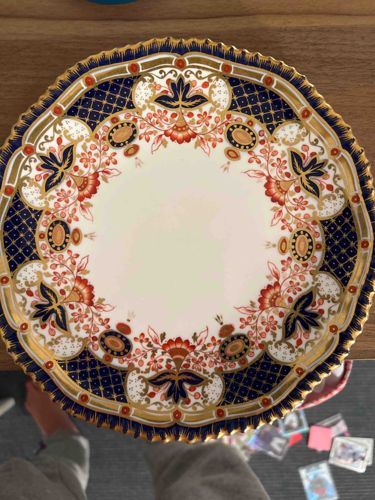
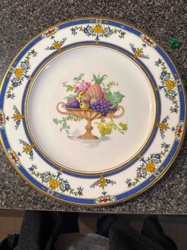
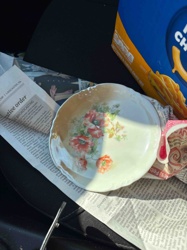
This item is a decorative porcelain plate, approximately 10-12 inches in diameter, featuring an intricate and ornate design. The plate's rim is scalloped or fluted, adding to its decorative appeal. The primary colors of the design are deep cobalt blue, rich terracotta or rust orange, and gold, set against a creamy white base. The outer band of the plate is a striking cobalt blue, adorned with a fine white cross-hatch or diamond pattern, giving it a textural appearance. This blue band is framed by broad gilded borders, suggesting extensive use of gold leaf or paint. Within the blue and gold border, there are stylized floral or botanical motifs in shades of terracotta, dark blue, and gold. Some of these motifs are contained within ornate, oval-shaped cartouches, while others cascade in a more organic, vine-like fashion towards the center of the plate. The central portion of the plate is a plain, undecorated creamy white, providing a visual resting point amidst the elaborate rim. The craftsmanship appears to be of high quality, with precise detailing in the painted elements and the consistent application of gold. There are no immediately visible signs of chips, cracks, or significant wear, suggesting the plate is in good to excellent condition. The gold trim seems largely intact, without major flaking or loss, which is common in older pieces with extensive gilding. The style of decoration, with its rich colors, intricate patterns, and heavy gilding, points towards a traditional European aesthetic, possibly English or Minton-influenced, indicative of a late 19th to mid-20th-century manufacturing period. Without a visible maker's mark, precise dating is challenging, but the overall presentation is one of luxury and fine artistry.
AI Appraisal Report
Based on my visual examination of the Ornate Gilded Porcelain Dinner Plate with Cobalt Blue and Floral Design, I assess its condition as good to excellent. The gilding appears largely intact, and there are no visible chips, cracks, or significant wear, which is remarkable for a piece of this likely age. The precision in the detailing and consistent application of gold suggest high-quality craftsmanship.
From the design elements—deep cobalt blue, rich terracotta, extensive gilding, and intricate floral motifs—this plate strongly evokes a traditional European aesthetic, possibly English or Minton-influenced, likely from the late 19th to mid-20th century. The style reflects a period of luxury and fine artistry in porcelain production.
In terms of market conditions, decorative plates of this caliber, especially those with extensive gilding and intricate hand-painted designs, generally hold a steady, albeit niche, demand. Comparables for high-quality, ornate porcelain dinnerware from this era indicate a market for collectors of antique and vintage decorative arts. While not exceedingly rare, pieces in excellent condition with such rich detailing are less common than more mass-produced items.
Factors significantly impacting value include the exceptional condition, the intricate design, and the apparent quality of the materials and artistry. The absence of a visible maker's mark is a limitation. For full authenticity verification, a physical examination is crucial to inspect for maker's marks on the reverse, assess the true condition of the gilding and porcelain surface, and to determine manufacturing techniques. Provenance documentation could also significantly enhance value and confirm origin. Without these, the authentication relies solely on visual style and condition.